

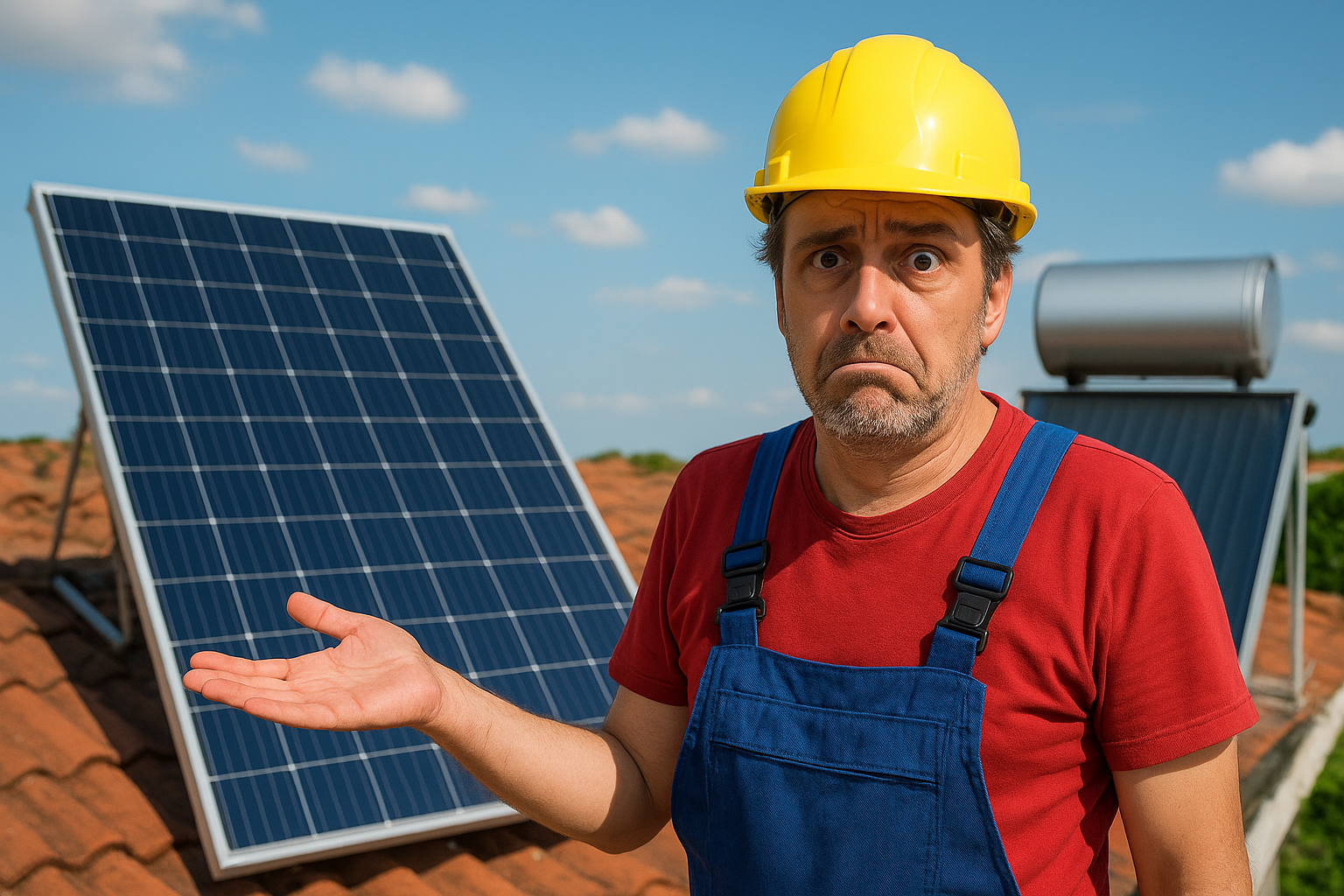
Solar thermal is that magical system that takes the sun (yes, the same one that tans you) and turns it into hot water for your shower, radiators (in some cases), or to supplement your home/office system. But beware: not all solar systems are the same. Here I explain clearly — and with a good dose of irony — the differences between natural solar thermal (thermosiphon) and forced solar thermal (forced circulation), when one or the other is convenient, and which mistakes to avoid so you don't turn your roof into a piece of modern art... unintentionally.
What is solar thermal (in a nutshell, and without equations)
A solar thermal system is mainly composed of:
solar collectors (flat or evacuated tube) on the roof that capture the sun's heat;
tank/storage where the hot water is stored;
circuit that connects collectors and tank (with or without a pump);
exchanger/valves and controls that manage who and when the water moves.
The main difference between natural and forced lies precisely in how the water (or heat transfer fluid) moves: by natural convection or thanks to a pump.
Natural solar thermal (thermosiphon): simplicity that loves the sun
How it works: it uses natural circulation: hot water rises, cold water sinks. That's why the tank must be installed higher than the collectors (often on the roof or immediately below).
Pros
Simple system: no pumps, no complicated electronics.
Lower initial and maintenance costs.
Reliable: fewer components = fewer breakdowns.
Perfect for small systems for domestic hot water (DHW).
Cons
Installation constraint: the tank must be above the collectors (not always practical or aesthetic).
Limited for large surfaces or long pipes: natural convection doesn't like distance.
Less control: no controller to "optimize" the flow.
Not ideal in very cold climates or where complex antifreeze protection is needed.
Often chosen when
Single homes with space on the roof/technical room above the panels.
Those who want a simple and economical solution for hot water.
Mild climate areas where the risk of freezing is low.
Forced solar thermal: the flexible and intelligent system
How it works: a pump moves the fluid (water or glycol mixture) between collectors and tank; a differential controller compares the temperature of the collectors with that of the storage and starts circulation when it is convenient.
Common variants: closed circuit with antifreeze (glycol), drain-back (fluid drains when the pump is off), integration with boiler, stratified storage.
Pros
Maximum flexibility: the tank can be wherever you want (ground floor, basement, technical room).
Works well with long pipes and larger systems (residential/condominium/industrial).
Antifreeze protection with glycol: useful in cold climates.
Controllers and sensors improve efficiency and reduce energy losses.
Possibility of advanced integration (buffer tanks, exchangers, space heating).
Cons
Higher initial and maintenance costs (pump, antifreeze circuit, electronics).
More components = more possible breakdowns (but manageable with proper maintenance).
Need for periodic checks on glycol, pumps, and valves.
Often chosen when
Medium/large systems or with significant distance between roof and storage.
Cold climates or places with risk of freezing.
Those who want integration with existing systems and maximum operational efficiency.
Practical differences at a glance
Storage position: above the panels = natural; wherever you want = forced.
Components: natural = minimal; forced = pump + controller + possible glycol.
Maintenance: natural = low; forced = regular (glycol every few years, pump check).
Efficiency/control: forced is superior for variable conditions and large systems.
Initial cost: natural is cheaper; forced requires more investment, but yields more in certain conditions.
Practical guidelines and “tricks” for choosing
Main purpose: just hot water for 2–3 people? A natural system may be enough. Want heating support or for a condominium? Forced.
Tank position: do you have space on the roof or above the collectors? Then natural is convenient. Otherwise, forced saves your design.
Climate: areas with frequent frosts → prefer forced with antifreeze.
Budget vs long term: natural costs less now; forced can give you more useful energy and integration (so you save over time).
Maintenance: if you don't want to think about the system, natural is more “forgettable”; if you want control and integration, prepare a service contract for the forced system.
Quick-sizing fashion (indicative, no magic formulas)
For simple domestic hot water: small domestic systems often use a few m² of collector (e.g. 1.5–3 m²) for 1–3 people; proportioned tank.
For heating support, larger surfaces and dedicated design are needed.
Note: correct sizing depends on climate, actual consumption, type of collector, and system integration — better to have a custom technical calculation.
Installation, classic mistakes and maintenance (so you don't cry after the first season)
Common mistakes:
Putting the tank in the basement and hoping for natural circulation. (It doesn't work that way.)
Ignoring the risk of freezing: collectors without antifreeze in a cold area = sadness and explosions.
Skipping the buffer tank or exchanger thinking “not needed.” Often it is very much needed.
Minimal maintenance (forced): check glycol every 3–7 years (depending on the product), check pump, possible air bleeding, clean collectors if dirty. For natural: simpler checks but still periodic inspections on pipe tightness and insulation.
In summary (no drama, but with common sense)
Solar thermal is a mature and very useful technology. If you want simplicity and initial savings, natural makes a good impression — especially for small systems and mild climates. If, on the other hand, you seek flexibility, integration with existing systems, antifreeze protection, and better overall performance (especially for larger systems), forced is almost always the most sensible choice.
If you want, I can prepare a mini-checklist for the site inspection or a “natural vs forced” comparison tailored to your home/office: you tell me the square meters, number of users, and if you live in a cold or mild area — and I'll give you the key points to decide (and a few jokes about how not to paint the roof shocking pink).