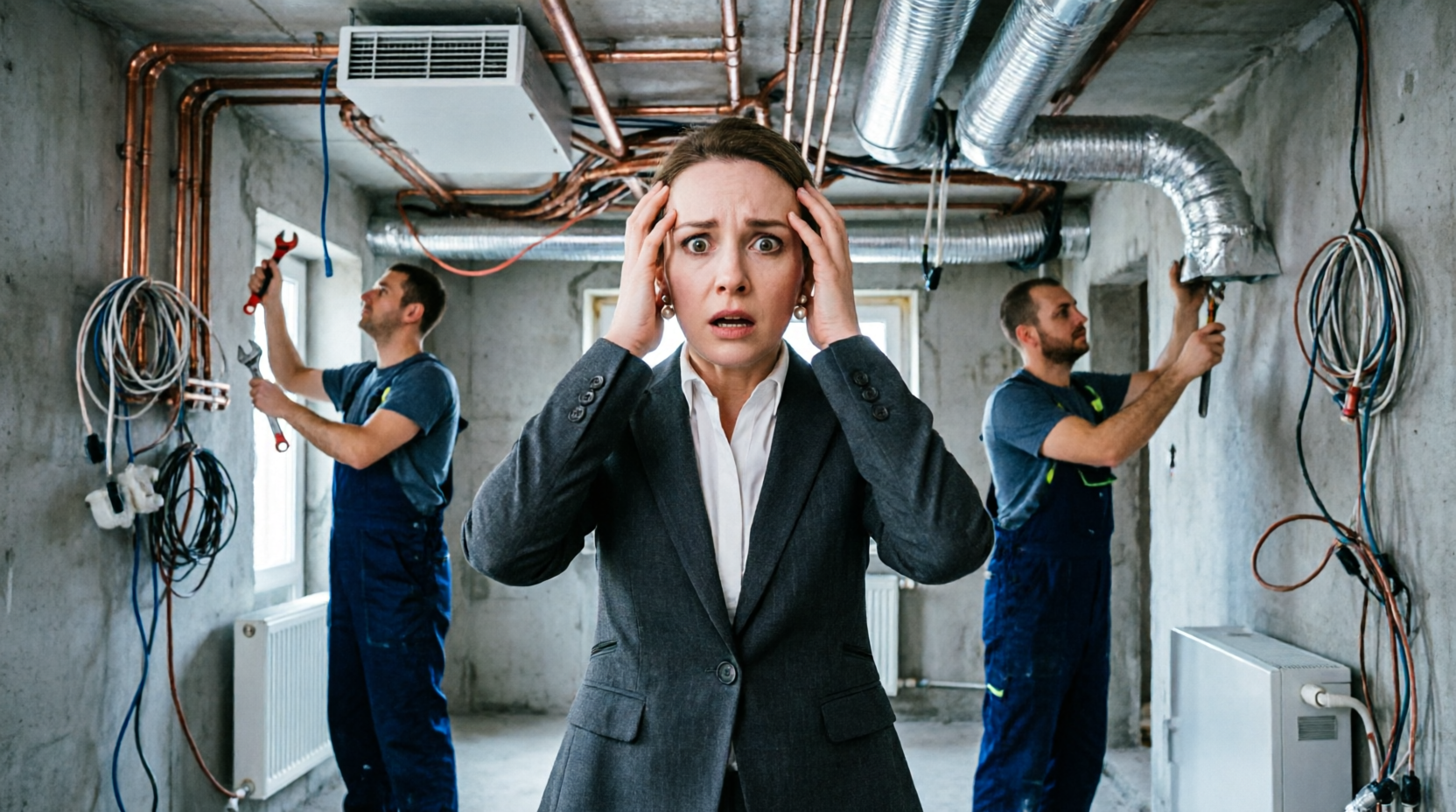


Let's start with a very Italian scene: windows closed because "it's cold," radiators turned up to the max, air that smells like last night's dinner, and glass that looks like a spa for condensation drops. Then someone says, "Open up for a moment, we're suffocating in here." The window is opened. Icy air comes in. The window is closed again. The heating is turned back on. And so on, in an endless cycle worthy of a Netflix series.
Well, VMC was created to put an end to this little theater.
VMC stands for Controlled Mechanical Ventilation. Translated from technical jargon: it's a system that changes the air inside your home continuously and intelligently, without forcing you to fling open the windows and without throwing out the heat (or coolness) you've paid for on your bill. It's like having a window always slightly open... but without drafts, without noise, and without that feeling of living in the middle of traffic.
The truth is simple: the air inside your home is often more polluted than outside. Yes, even if you live in a quiet area. You cook, you shower, you breathe (that's enough on its own), you dry clothes, you use detergents, new furniture releases substances, humidity rises. In a modern, well-insulated apartment, little air comes in and even less goes out. The result? You accumulate carbon dioxide, humidity, and invisible pollutants that don't make a scene but silently work against your comfort and health.
VMC does something very simple and ingenious: it expels stale air and brings in new air filtered from outside. And here's the detail that changes everything: in systems with heat recovery (which are the most sensible choice today), the outgoing air transfers up to 70–90% of its heat to the incoming air. Basically, you recycle thermal energy without mixing the flows. You're not throwing away your heating, you're just changing the air in a smart way.
"But I open the windows." Sure. I also use a paper map sometimes. It works, but it's not exactly the height of convenience. Opening the windows for 5 minutes a day doesn't guarantee constant air exchange. And if there's traffic, pollen, or smog outside, you're letting it all in. VMC, on the other hand, filters the incoming air, retains fine dust and allergens, and maintains a continuous exchange, even when you're out or sleeping.
And here we come to the point that many discover too late: air quality affects sleep, concentration, mood. It's not poetry, it's physiology. In environments with high CO₂ concentration, above 1000 parts per million, you feel tired and have trouble focusing. A closed bedroom all night can easily exceed that value. With an active VMC, the air remains more stable, fresher, more "light." And waking up is no longer a union negotiation with your pillow.
Then there's the humidity issue, which in Italy is almost a religion. Too much humidity means mold, stained walls, persistent odors, paint that bubbles. Too little means dry air, irritated throat, respiratory discomfort. VMC helps maintain a more constant balance, reducing peaks after showers, cooking, or rainy days. It doesn't work miracles if the house has structural problems, but it's a powerful tool for stabilizing the indoor microclimate.
"Is it just for new houses?" No. Of course, in new buildings it's almost standard, especially in high energy efficiency buildings. But there are centralized solutions for complete renovations and decentralized systems, more compact, installable even in single rooms without turning everything upside down. You don't need to turn your home into an endless construction site. You just need good planning.
And here comes a concept that we at Gruppo Impianti Ristrutturazioni know well: the system is not an accessory, it's part of the architecture of comfort. A VMC installed "just because" can be noisy, poorly regulated, ineffective. A VMC designed considering insulation, windows, heating, and the habits of those living in the house becomes invisible. And when a system is invisible but improves life, it means it was well thought out.
There's also an economic aspect that deserves honesty. Yes, it's an investment. But in a well-insulated house, without controlled ventilation, you risk having to air out by opening windows in winter or summer, losing energy every day. Plus, preventing mold and condensation means avoiding restoration work, anti-mold paints every two years, and domestic stress worthy of a soap opera.
The ironic thing is that many people don't know what a VMC is... until they try one. Then they start to notice they no longer smell last night's dinner in the morning, the windows don't "cry" in winter, and the air is just different. It's not a noisy revolution. It's a silent improvement. And that's exactly why it's powerful.
In an era when we talk about smart homes, home automation, intelligent houses, we often forget the most basic thing: breathing well. A house can have a fridge connected to Wi-Fi and lights controlled by a smartphone, but if the air is stagnant, it's not really modern. It's just technological.
VMC is not a fad. It's a technical answer to a real problem created by increasingly insulated homes. And the more we insulate, the more an active air exchange management becomes necessary. It's a bit like going to the gym: if you move little, your body stiffens. If the house doesn't "breathe," it gets sick.
So why should everyone have one, even those who don't know what it is? Because everyone breathes. And because comfort is not measured only in degrees on the thermostat, but in air quality, humidity balance, silence, stability.
The difference between an ordinary house and a house that really works often lies in the things you can't see. VMC is one of those. It doesn't make a splash on Instagram. You don't show it off to friends like your new parquet. But when you live in an environment that breathes well, you notice it every day.
And once you get used to that air... going back is like giving up Wi-Fi. Technically possible. Psychologically, very difficult.