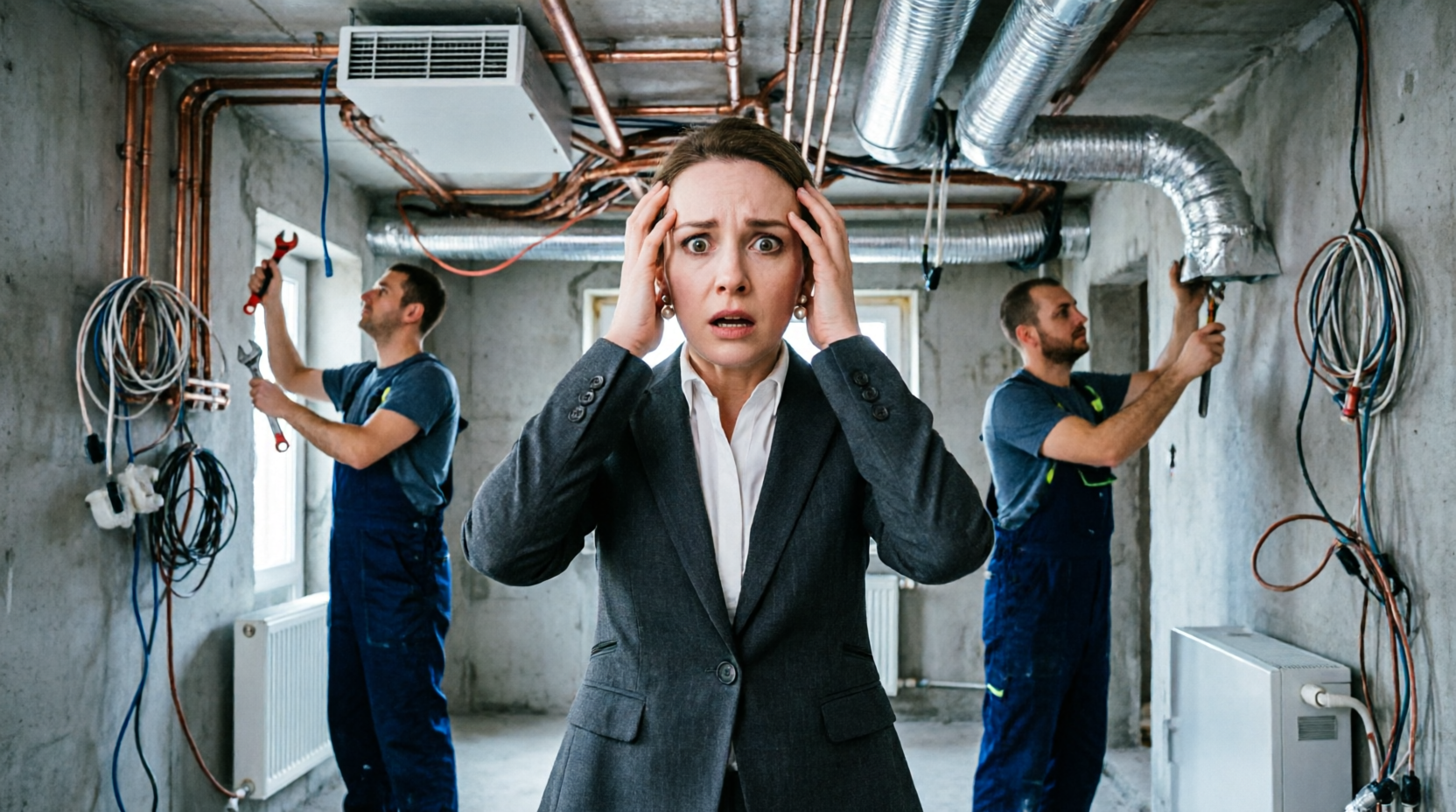


There is one thing that almost all Italian offices have in common.
No, it's not the coffee machine always breaking down when you need it most.
Nor is it the meeting scheduled at 6:00 pm with the subject “quick alignment.”
It's the air.
That invisible, seemingly harmless air that we breathe for 8, 9, sometimes 10 hours a day... and which is often the real culprit behind headaches, chronic fatigue, drops in concentration, widespread irritability, and productivity worthy of an endless Monday morning.
Because yes: office air can literally decide how well we work.
And in most cases... it decides badly.
The illusion of the “well-sealed” office
For years we have pursued a single goal: insulating buildings.
High-performance windows.
Thermal insulation.
Perfect seals.
Continuous air conditioning.
The result? Energy-efficient offices... but sealed like a jar of jam.
The problem is that inside that jar, there’s us.
We breathe. We talk. We print. We turn on computers. We produce heat, humidity, CO₂, and a surprising amount of invisible pollutants.
And without proper air exchange, everything stays there.
Floating around.
Being breathed in again.
And again.
And again.
When bad air becomes a business cost
Many entrepreneurs think that air quality is a topic for “environmentalists” or particularly romantic architects.
In reality, it’s an economic issue.
Poor indoor air causes:
decreased concentration
increase in errors
greater mental fatigue
absences due to recurring ailments
loss of cognitive performance
Several studies in the field of Indoor Environmental Quality show that high levels of CO₂ reduce decision-making ability by up to 20-30%.
Translated into business language:
you’re paying full salaries for brains working in energy-saving mode.
Not exactly a brilliant investment.
The real enemy: what you can't see
When it comes to office air, many people imagine dust or bad smells.
In reality, the main problems are invisible:
accumulated carbon dioxide
volatile organic compounds released by furniture and printers
uncontrolled humidity
bacteria and fine particulate matter
stagnant air
The classic modern office full of PCs, carpeting, laminated furniture, and air conditioners never sanitized easily becomes a small ecosystem... not always a friendly one.
And here the paradox arises.
The more modern the office, the more it risks having worse air.
Opening the window is not the solution (even if your grandma says so)
The most common solution remains the same:
“Let’s open up for a moment.”
Does it work?
Yes.
But only for a few minutes.
Then something predictable happens:
cold comes in during winter
heat comes in during summer
the thermostat war begins
someone gets sick
the window is closed forever
Manually opening windows is a random, discontinuous, and inefficient solution. It guarantees neither constant quality nor humidity control.
It’s like trying to air condition an office using a fan.
The turning point: ventilate without wasting energy
This is where one of the most underrated interventions in the office world comes into play: controlled mechanical ventilation.
Controlled Mechanical Ventilation (CMV) allows you to continuously exchange indoor air without opening windows and without losing thermal energy.
In practice, this happens:
the stale air is expelled, new air comes in filtered and at the correct temperature.
Always.
Silently.
Automatically.
The result is not just cleaner air.
It’s a stable, breathable, and cognitively more high-performing environment.
Many companies discover the benefit only after installation, when they start hearing phrases like:
“I don’t know why, but it’s easier to work in here.”
Spoiler: it’s the oxygen.
Air conditioner ≠ clean air
Very common mistake: thinking that the air conditioner improves air quality.
The air conditioner cools or heats. Period.
If it’s not integrated with a ventilation system, it simply keeps circulating the same indoor air.
It’s a bit like continuously stirring your coffee without adding any more.
After a while... it’s still the same.
And if the filters are not sanitized regularly, the system can even become a source of contamination.
Humidity: the silent saboteur
Too much humidity creates mold and a feeling of heaviness.
Too little causes dry eyes, irritation, and fatigue.
The ideal range is between 40% and 60%.
Outside this range, perceived comfort drops drastically even if the temperature seems perfect.
That’s why in many offices you feel cold at 22°C and hot at 24°C: it’s not the temperature that’s the problem, but the balance of the air.
The direct link between air and productivity
An office with quality air produces almost immediate effects:
meetings last less.
Concentration increases.
People feel less tired in the afternoon.
The feeling of a “heavy head” decreases.
It’s not corporate motivation.
It’s not coaching.
It’s not team building.
It’s physiology.
The human brain consumes about 20% of the body’s oxygen. When air quality worsens, the first thing to slow down is precisely the brain.
And a company made up of tired brains makes slow decisions.
The new luxury of modern offices
Once, the prestige of an office was measured by:
parquet flooring
designer furniture
scenic reception
Today, the real invisible luxury is a healthy environment.
The most advanced companies are investing in indoor environmental quality because they have understood one simple thing:
it’s not enough to attract talent.
You have to put them in the conditions to perform well.
And air is the first element of the work environment.
Before the desk.
Before the light.
Even before the coffee (although some might argue about this).
The most important advice (that almost no one follows)
Before taking action, you need to measure.
CO₂, temperature, and humidity sensors reveal the true health of an office in just a few hours.
Often the discovery is surprising: seemingly perfect environments show carbon dioxide levels worthy of a meeting room after three hours of brainstorming... at 9:30 in the morning.
And from there it finally becomes possible to design a real, not improvised, solution.
Breathe better to work better
Improving air quality in the office is neither a technological whim nor a green fad.
It’s a strategic choice.
Because every company constantly invests in software, training, marketing, and organization... but often forgets the element that influences everything else: the environment where people spend most of their day.
Air is invisible.
It makes no noise.
It doesn’t appear in the balance sheets.
But it affects every decision made within those walls.
And sometimes the difference between a tired team and a productive one is not a new management system.
It’s simply... breathing better.