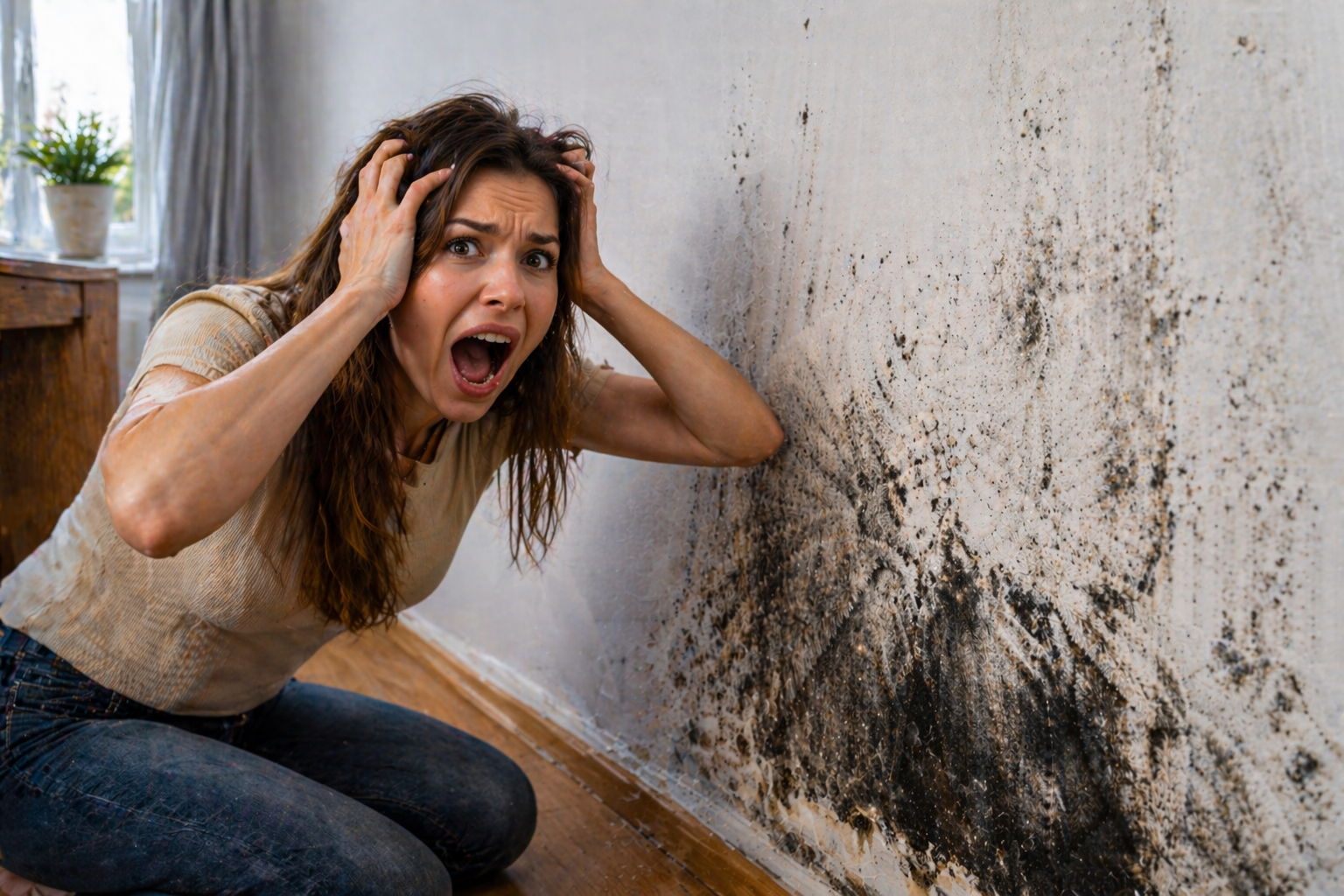


There’s a roommate no one ever invited, no one ever introduced to friends and, above all, no one has ever seen sign a contract.
Yet it’s there.
Silent.
Persistent.
Slightly unsettling.
Mold.
It shows up in bathroom corners as if it sprouted overnight. It peeks out behind a wardrobe with the air of someone who “was already here before.” It spreads across the ceiling with a confidence that, frankly, many regular tenants have never had.
And the most irritating thing?
It doesn’t pay rent.
The big misunderstanding: “it’s just damp”
When people talk about mold, the first reaction is often to downplay it.
“It’s a bit of damp.”
“Just open the windows.”
“Come on, I’ll wipe it with a product and that’s it.”
If it were really that simple, we wouldn’t be talking about one of the most widespread problems in homes.
Mold isn’t just an aesthetic nuisance.
It’s the visible result of a completely off balance inside the home. A balance made of humidity, temperature and ventilation that, when it combines in the “right” way (for it), creates the perfect environment to thrive.
In more technical terms, everything revolves around a phenomenon called condensation.
And no, it’s not lab stuff.
It’s what happens every day on the walls of your home.
Physics working against you (without asking permission)
The air we breathe always contains a certain amount of moisture.
When this warm, humid air comes into contact with a cold surface—like a poorly insulated wall or an exposed corner—the water vapor turns into water.
That water settles.
And where there’s water, sooner or later she shows up.
Mold.
It doesn’t take much.
You don’t need an obvious leak.
A temperature difference and a bit of constant humidity are enough.
And just like that, your wall officially becomes a perfect studio apartment for colonies of microorganisms.
Mold’s favorite spots (spoiler: they’re not random)
Mold isn’t creative.
It’s strategic.
You almost always find it in the same places:
wall corners
behind furniture
bathroom ceilings
areas near windows
Not because it likes variety.
But because these are the coldest, least ventilated areas and the most exposed to condensation.
It’s a bit like it’s scouting real estate… but only to find the worst spots in the house.
The myth of the quick fix
Here comes the moment of truth.
The anti-mold spray.
You spray it.
The mold disappears.
You feel satisfied.
Problem solved?
Not really.
You’ve just erased the symptom, not the cause.
It’s like taking a painkiller for a structural issue: you feel better for a while, but the problem stays there, quietly waiting for its moment to come back.
And in fact it comes back.
Always.
When mold stops being “just ugly”
Beyond the look (which is already not great), mold has a real impact on air quality and health.
The spores it releases spread through the space and can contribute to irritation, allergies and breathing problems.
This is where another key concept comes in: indoor air quality.
Because it’s not enough to have a beautiful home.
It has to be healthy too.
And a home with mold, unfortunately, isn’t.
The uncomfortable truth: often the problem is the house, not the people living in it
Many people get told:
“You need to air it out more.”
“You shouldn’t dry clothes indoors.”
“You have to be careful.”
All true, sure.
But not always enough.
In many homes the problem is structural:
insufficient insulation
thermal bridges
poor ventilation
In these cases, even the most virtuous behavior in the world isn’t enough.
It’s like trying to empty a tub with a cup while the tap is running.
The real solution: change the rules of the game
To truly eliminate mold, you have to act on the causes.
And here the paths differ, but they all share one goal: prevent the ideal conditions for condensation from forming.
Improving thermal insulation means avoiding cold surfaces.
Managing air exchange in a controlled way means reducing indoor humidity.
And when we talk about effective ventilation, we’re talking about mechanical ventilation with heat recovery, a system that lets you change air continuously without randomly opening windows.
Translated: less humidity, less condensation, less mold.
And more comfort.
The paradox of modern homes
There’s an interesting detail.
Modern homes, more insulated and efficient, are also more “sealed.”
That’s great for energy use.
But it can become a problem if ventilation isn’t managed properly.
Fewer drafts = fewer losses… but also less natural air exchange.
And guess who’s happy about that?
Exactly.
Her again.
When you realize you’ve won
The moment you know you’ve truly solved the problem is very simple.
Weeks go by.
Then months.
Then winter.
And the mold doesn’t come back.
No stains.
No smells.
No suspicious corners.
The house is dry, the air feels lighter, and comfort changes in an obvious way.
And above all you’ve finally freed your home from a squatting roommate who, besides not paying rent, was also causing damage.
A cohabitation that makes no sense to continue
Mold isn’t inevitable.
It isn’t normal.
It isn’t something you have to live with.
It’s a technical problem with technical solutions.
The point is to stop treating it as a superficial issue and start seeing it for what it is: a clear sign that something, in the house, isn’t working the way it should.
And when you start truly fixing that something… mold finally does the only sensible thing it can do.
It leaves.
Without saying goodbye.