
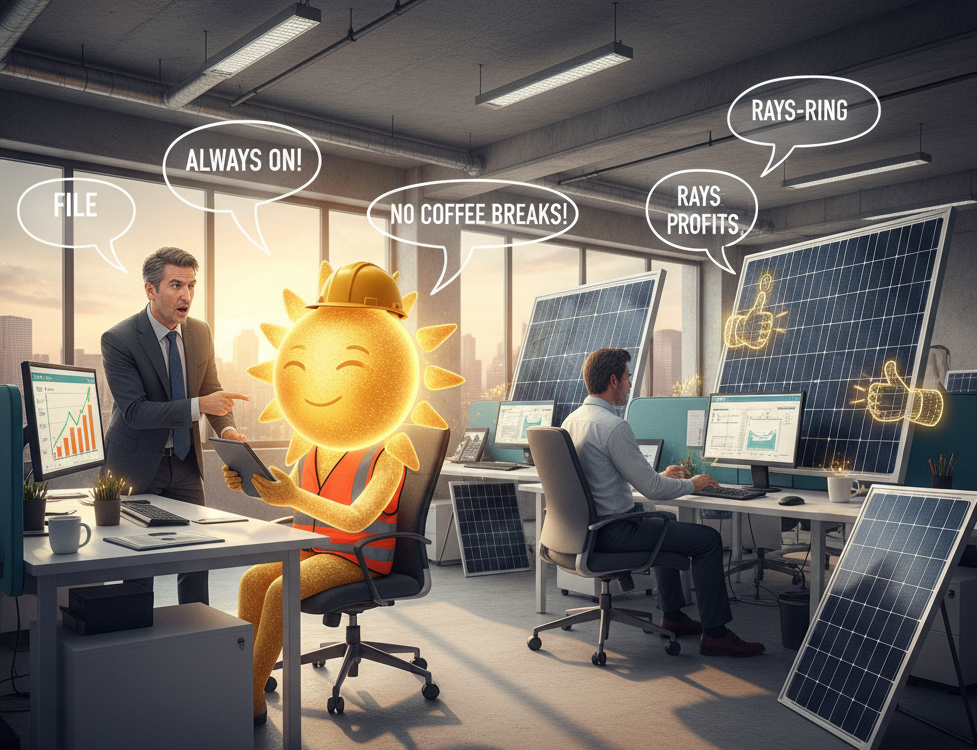

Imagine a colleague who never asks for vacation, never gets sick, works every day (when the sun is out), and — icing on the cake — at the end of the year brings you a few thousand euros less on your energy bill and a couple more points in your ESG report. No, it’s not magic: it’s simply photovoltaics (and other renewables) when they enter a company with planning, a project, and a good dose of pragmatism.
This article is for the curious entrepreneur, the facility manager tired of high bills, and for those who really want to understand how renewables can change company life — with numbers, practical advice, mistakes to avoid, and a pinch of irony because otherwise it would all be too boring. Grab a coffee (better if made with self-produced electricity) and let’s get started.
1. Why it pays to introduce renewables in your company (and it’s not just for the Planet)
Reduction of energy costs: producing part of the electricity you consume reduces dependence on the grid and volatile prices.
Control of the energy budget: with self-produced energy you have predictable costs for years.
Image improvement (ESG): customers, suppliers, and investors appreciate companies with decarbonization strategies.
Operational resilience: systems with storage or renewable generators can ensure continuity in case of grid interruptions.
Financing opportunities and incentives: there are often tools to reduce the initial investment.
Reduction of emissions and future compliance: anticipating regulations avoids rushed and costly investments later.
2. Which technologies are worth considering (practical overview)
- Photovoltaic (PV) on roofs or canopies: the “basic” choice for most companies. Efficiency, scalability, and falling costs make it the first candidate.
- Storage batteries: increase self-consumption, enable peak shaving and backup.
- Heat pumps for industrial heating/cooling or process water (where applicable).
- Biomass/biogas cogeneration: for companies with organic waste or in specific agricultural/industrial contexts.
- Solar thermal: for hot water in processes or low-temperature industrial heating.
- Wind and large-scale solar: for large sites and companies with available space or strong net energy dependencies.
3. First practical question: how much can I produce and how much do I save? (numerical example)
Let’s take a realistic but simplified example for a medium-sized company that wants to understand the numbers. Attention: these are illustrative numbers; always ask for a simulation with the real site data.
Hypothetical data:
- Annual company electricity consumption = 150,000 kWh/year.
- Chosen photovoltaic system: 100 kWp (on the roof or canopies).
- Estimated specific production = 1,300 kWh per kWp per year (average hypothetical value).
- Annual production calculation: 100 kWp × 1,300 kWh/kWp = 130,000 kWh/year.
Digit-by-digit: 100 × 1300 = 130000. - Self-consumption hypothesis (without batteries): 50% of the production is consumed directly by the company, the rest is fed into the grid or otherwise valued.
- Self-consumption = 130,000 × 0.50 = 65,000 kWh/year.
Calculation: 130000 × 0.5 = 65000. - Average price of energy purchased from the grid (assumption): 0.20 €/kWh.
- Direct annual savings = 65,000 kWh × 0.20 €/kWh = 13,000 € / year.
Calculation: 65000 × 0.20 = 13000.00. - Hypothetical investment (including installation costs): 800 €/kWp → for 100 kWp = 100 × 800 = 80,000 €.
Calculation: 100 × 800 = 80000. - Simple payback (without incentives, not considering maintenance and depreciation): 80,000 € ÷ 13,000 €/year ≈ 6.15 years.
Calculation: 80000 ÷ 13000 = 6.153846... → rounded 6.15 years.
Practical conclusion: with these assumptions, the investment pays for itself in just over 6 years — a good figure in business terms. If you add batteries, incentives, or better self-consumption profiles, the payback time changes (usually improves with smart management and incentives).
Important note: all figures must be simulated case by case. Specific production, load profile, energy price, and installation costs vary greatly.
4. How to size the system: four practical rules
Start from the real load profile: download hourly consumption data (if you have smart meters) to understand when you consume and how much you can self-consume.
Maximize self-consumption before increasing PV power: it’s often more efficient to install a system that increases the share of self-consumption (load management, scheduling, storage) rather than adding panels that generate energy when the company is closed.
Evaluate DC/AC power and clipping: small oversizing of the PV field compared to the inverter can be advantageous, but requires simulations.
Consider batteries if you have strong evening peaks or TOU prices: storage is useful to shift energy to the right time, do peak shaving, and offer backup, but it’s expensive — always evaluate the cost/benefit ratio.
5. Smart energy management: the real secret for maximum savings
Installing panels and leaving everything as is isn’t enough. The most successful energy companies integrate:
EMS (Energy Management System) to orchestrate production, storage, and loads.
Load shifting and scheduling: turning on ovens, pumps, or machines during surplus hours.
Integrations with control systems (SCADA/PLC) for industrial processes.
Automations for thermal vectors (heat pumps + PV) to shift consumption where needed.
A good EMS can turn a photovoltaic system into a source that produces real value every day.
6. Financing and incentives: possible options
- Direct purchase: best for those with liquidity and looking at long-term ROI.
- Operating/financial leasing: reduces the initial investment, the leasing company retains ownership until redemption.
- PPA (Power Purchase Agreement): a supplier finances and manages the system; the company buys the energy at an agreed price (useful if you don’t want to invest).
- Tax incentives and local grants: often available, reduce the net cost; always check the updated conditions.
Choosing the right formula is strategic: the PPA reduces the CAPEX burden but limits the direct benefit; direct purchase maximizes savings but requires capital.
7. Permits, constraints, and bureaucracy: don’t let them become a roadblock
- Check urban and landscape constraints (especially in protected areas).
- Interface with the local distributor for connection and GSE procedures (or equivalent authority).
- Check fire prevention, workplace safety for the construction site, and environmental regulations.
- Plan the timing: procedures and permits can take weeks or months.
Tip: involve the technical office or an expert consultant early, not at the last minute.
8. Operational management and maintenance
Routine maintenance: panel cleaning, inverter checks, software updates.
Performance monitoring: remote monitoring to identify production losses.
Preventive maintenance plans: reduce downtime and repair costs.
Warranties and SLAs: check panel warranties (20–25 years guaranteed productivity) and inverters (5–10 years, extendable).
9. Most common mistakes (and how to avoid them)
Not measuring the consumption profile → wrong sizing.
Buying “the lowest price” without checking quality and warranties → problems after a few years.
Ignoring peak management and self-consumption → system that doesn’t perform as it could.
Not considering shading or orientation → significant production loss.
Underestimating the need for an EMS → missed potential.
10. Company use cases (practical ideas)
- Manufacturing company: PV + batteries + EMS to reduce power peaks and use surplus for evening heating.
- Company parking lot: photovoltaic canopies with EV charging stations for the company fleet.
- Agricultural company: PV + biogas from waste + heat pumps for drying or greenhouse heating.
- Companies with thermal processes: integration of solar thermal and heat pumps to reduce diesel/methane use.
11. Quick checklist to get started (bring it to your technician)
- Consumption analysis (hourly, weekly, seasonal).
- Inspection of roof/available areas and check for shading.
- Simulation of specific production and estimated self-consumption.
- Technical quotes (at least 2–3) including ROI and scenarios.
- Evaluation of financing options (purchase, leasing, PPA).
- EMS project and load management strategies.
- Check procedures and permits with distributor and municipality.
- Maintenance plan and clear warranties.
12. Hire the sun, but do it wisely
The sun really is an ideal colleague: works for free (almost), doesn’t complain, and makes your company greener and more efficient. But as with any good hire, you need a clear job description, a serious onboarding (project), and management tools. Renewables in a company work when they are intelligently integrated: production, storage, automation, and company behaviors must go in the same direction.