

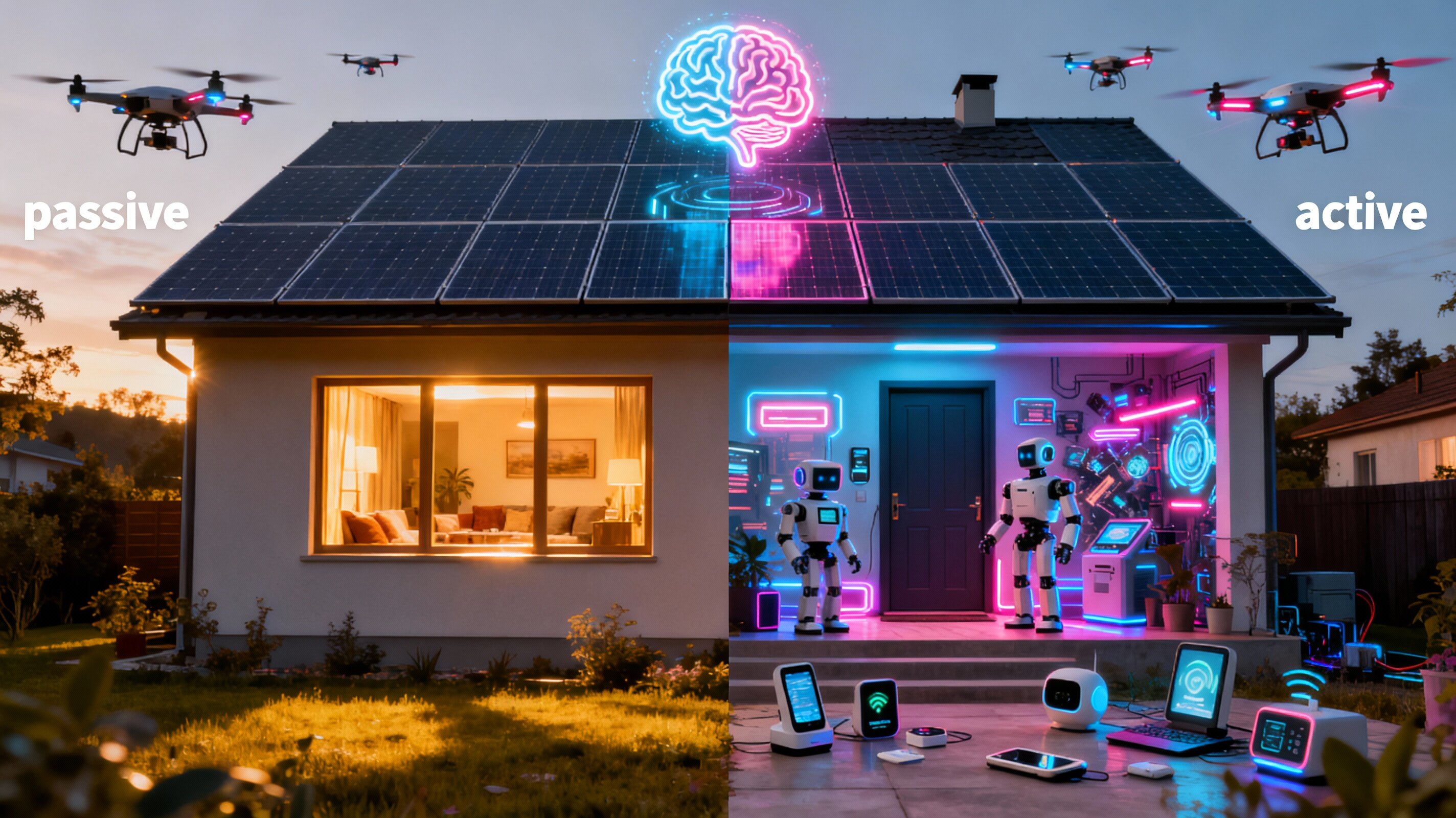
Imagine two houses sitting at the neighborhood bar. The first arrives wrapped in a soft thermal coat, sipping hot tea and is calm: this is the passive house. The second walks in with a tablet, managing solar panels, batteries, and heat pumps with the skill of a DJ: this is the active house. Which is better? It depends: on the climate, your wallet, your willingness to tinker with apps and — let’s admit it — your laziness in programming the washing machine at 3 a.m.
This article explains, with a practical tone, concrete numbers and a good dose of irony, what these two housing philosophies are, how they compare, when one or the other (or both) is worthwhile, how to intervene in an existing house, and which mistakes to avoid so you don’t turn your “green” project into a collection of confusing bills.
1. Quick definitions (to start without confusion)
Passive house (or Passivhaus): a building designed and constructed to minimize energy demand for heating and cooling. Principles: continuous insulation, no thermal bridges, highly efficient windows, controlled mechanical ventilation with heat recovery. The typical Passivhaus standard target is a heating demand below 15 kWh/m²·year.
Active house (or building active): a building that is not only efficient, but also produces, stores, and manages energy intelligently. Typical elements: photovoltaics, batteries, heat pumps, energy management systems (EMS), integration with electric mobility and IoT technologies. The emphasis is on production and management, not just reducing demand.
Note: the two strategies are not mutually exclusive — in fact, they are complementary. A passive house spends very little; an active house can make that minimal remaining energy “neutral” or even export it.
2. Key principles of the passive house (the tricks you don’t see)
Continuous insulation: coat, floors, and roofs insulated homogeneously.
High-performance windows: low-emissivity glass and thermally broken frames.
Airtightness: measured with the blower-door test; fewer leaks = less waste.
Controlled mechanical ventilation with heat recovery (CMV): clean air and heat recovered from exhaust air.
Simple design of passive solar gains: orientation and shading managed to exploit the sun in winter and avoid it in summer.
3. Essential components of the active house (the brain and the muscles)
- Photovoltaics (PV): produces electricity during daylight hours.
- Storage batteries: store surplus for the evening and peaks.
- Heat pumps: for heating and hot water with high COP.
- EMS and smart meters: monitor and decide when to charge, discharge, or use the grid.
- Integration with electric vehicles: the house charges the car when convenient or uses it as a buffer source (V2G, if available).
The idea is to turn the building into a mini integrated energy system.
4. A comparison with numbers (simple, clean and digit-by-digit)
Let’s take a concrete example to see the difference in energy and economic terms. Let’s consider a 120 m² house in a temperate climate.
- Case A — Traditional house (not well insulated)
Heating demand: 120 kWh/m²·year (example of single uninsulated masonry).
Annual energy for heating = 120 kWh/m²·year × 120 m².
Calculation: 120 × 120 = 14,400 kWh/year.
- Case B — Passive house
Heating demand: 15 kWh/m²·year (Passivhaus target).
Annual energy for heating = 15 × 120.
Calculation: 15 × 120 = 1,800 kWh/year.
Annual energy savings for heating:
Difference = 14,400 − 1,800.
Calculation: 14400 − 1800 = 12,600 kWh/year saved.
Economic value (if we use an energy cost reference of 0.25 €/kWh):
Annual monetary savings = 12,600 kWh × 0.25 €/kWh.
Calculation: 12,600 × 0.25 = 3,150.00 € /year.
So, just for heating, transforming a poorly insulated house into a passive house (ideally) could save about €3,150 per year in our example (at hypothetical rates). Note: these numbers are indicative — every house, climate, and heating system varies.
5. Where the active house comes in: multiplying the value
The active house aims to reduce purchased energy (and costs) as well as make the house resilient. Here’s how it integrates the above numbers:
If the passive house (120 m²) reduces the demand to 1,800 kWh/year, installing photovoltaics can cover part of that electric demand (for example, heat pump and electric uses).
Suppose a PV system of 6 kWp produces, in that area, 6 kWp × 1,100 kWh/kWp/year = 6,600 kWh/year.
Calculation: 6 × 1100 = 6,600.
With smart self-consumption and a battery, much of the 1,800 thermal kWh (if electric via heat pump) could be covered by PV, turning the savings already achieved with passivity into almost zero bills.
6. Costs and returns: how much do you spend to reach these numbers?
- Passive house (new construction): design and construction costs are higher than a traditional build due to details, materials, and testing. An indicative increase in construction cost can range from 5% to 15% compared to commonly used standards (variable), but the benefit is a much lower bill and higher property value.
- Retrofit to passive standard: more complex and expensive for individual interventions (coat, windows, CMV) but possible; the cost depends on accessibility, surface area, and complexity (typically several tens of thousands of euros for a detached house).
- Active house (PV + batteries + heat pumps): additional investments (e.g. 6 kWp PV may cost X €, batteries Y €, heat pump Z €) — payback depends on incentives, energy prices, and self-consumption.
Important: incentives and deductions (ecobonus, conto termico, tax deductions, invoice discounts, local grants) greatly change the economics: in many cases, they drastically reduce payback times.
7. Pros and cons (practical summary)
Passive house
Pros
- Minimal heating consumption.
- High comfort (warm walls, less drafts).
- Reduced need for complex heating systems.
Cons
- Initial investment (especially in retrofit).
- May require attention to air exchange and humidity management.
Active house
Pros
- Potential to eliminate bills (or sell energy).
- Greater resilience (backup, peak management).
- Flexibility: adapts to different needs (EV, home industrial loads).
Cons
- Investment in technologies (PV, batteries) and management.
- Requires management skills or a good EMS.
- Production is intermittent (sun), though mitigated by storage.
8. What is the right choice for you?
If you’re building from scratch: aim for the passive house. It makes more sense to design the efficient envelope and then, if you wish, add PV and battery. The combination is best.
If you’re renovating: first consider interventions on the envelope (coat, windows, CMV). After reducing demand, consider PV and heat pump: this way the system needs less power and costs less.
If you want to eliminate the energy bill immediately but can’t or don’t want to intervene on the envelope: invest in active solutions (PV + batteries + heat pump), but expect the bill to drop significantly only with good self-consumption and management.
Golden rule: first reduce demand, then add production. It’s cheaper to reduce the required kWh than to produce them all.
9. Common mistakes to avoid (and a few jokes to remember them)
Buying lots of kW of panels and leaving the walls cold. It’s like putting a wool coat over a wet t-shirt.
Installing large batteries without first reducing consumption. Don’t turn the garage into a giant cellphone depot if the house is a thermal sponge.
Choosing heat pumps not sized for real use (flow too high for traditional radiators). The most efficient pumps want low-temperature terminals (underfloor heating).
Ignoring CMV maintenance — clogged filters = worse air, collapsed efficiency.
Thinking of incentives as a constant: they change over time; get informed before planning.
10. Practical steps for those who want to start today
- Do an energy audit: measure real demand (consumption, losses, thermal bridges).
- Prioritize envelope interventions: coat, windows, attic.
- Consider CMV with heat recovery if the house is very airtight.
- Design a PV system sized for real use, not the romantic desire to “cover everything.”
- Plan integration (heat pump + battery + EMS) after reducing demand.
- Request multiple quotes and check references: installation matters as much as the material.
11. Concise checklist to bring to the installer / designer
- Updated energy audit.
- Target U-values for walls/floors/windows.
- CMV solution and indoor air quality.
- PV system sizing after efficiency interventions.
- Estimate of electric and thermal demand post-intervention.
- Storage and management options (EMS).
- Quotes with payback analysis and incentive assumptions.
- Material warranties and after-sales support.
12. Watts, brains, and common sense
The question “passive house or active house?” is poorly posed if you expect a single, definitive answer. The real future of living is efficient house + active intelligence: reduce demand (passive), then produce and manage the little that’s needed (active). It’s a two-track relationship: the smart envelope and the energy brain work together.