There is a precise moment in every human being's life when they realize that the bathroom is no longer just a bathroom. It usually happens when a tile comes off, the mixer leaks, or the vanity unit makes that unsettling noise that seems to say: “I’ve given everything, now you’re on your own.”
And that’s exactly when the big existential question arises: is it better to have a minimalist or a classic bathroom?
The short answer is: it depends.
The long answer is: it depends much more than you think, and especially not in the way you believe.
Because today’s trends are doing something surprising: they are mixing, overturning, and poking fun at both schools of thought. And yes, you’re probably about to discover that the bathroom you thought was “super modern” is already outdated, while the one you feared was “grandma style” is suddenly cool.
The minimalist bathroom: fewer things, more character (and a few paranoias)
For years, minimalism was the undisputed king of bathrooms. Clean lines, smooth surfaces, neutral colors, wall-hung fixtures, and the constant feeling that if you leave a shampoo bottle out of place, an alarm will go off.
The minimalist bathroom was born with a very enticing promise: mental order through visual order. Few elements, everything hidden, no frills. The problem is that, in real life, we humans have toothbrushes, hairdryers, hair products, creams “that maybe I’ll use one day,” and towels that never fold as neatly as in the renderings.
The new minimalist trend, in fact, is changing its skin. It’s no longer cold and aseptic like an operating room, but becomes warm, tactile, imperfect in just the right way. Today’s minimalism loves real wood (not the fake kind that “looks real”), slightly textured surfaces, natural stones, sand, taupe, greige, and earth tones.
It’s no longer “nothing,” but very little, chosen well.
A minimalist sink today doesn’t have to be glossy white and invisible: it can be matte ceramic, colored resin, or carved stone. The vanity doesn’t have to disappear, but integrate. The mirror isn’t just a mirror: it’s backlit, heated, smart, and probably judges you while you look at yourself at 7 a.m.
Minimalism evolves because it has understood one fundamental thing: it’s not enough to remove, you have to design.
The classic bathroom: the one you thought was outdated (but it’s not)
Now let’s talk about the great misunderstanding. The classic bathroom. The one that, in the collective imagination, smells of dark furniture, golden borders, and faucets that look like they came out of a period film.
Well, forget all that.
The new classic is not nostalgia, it’s conscious elegance.
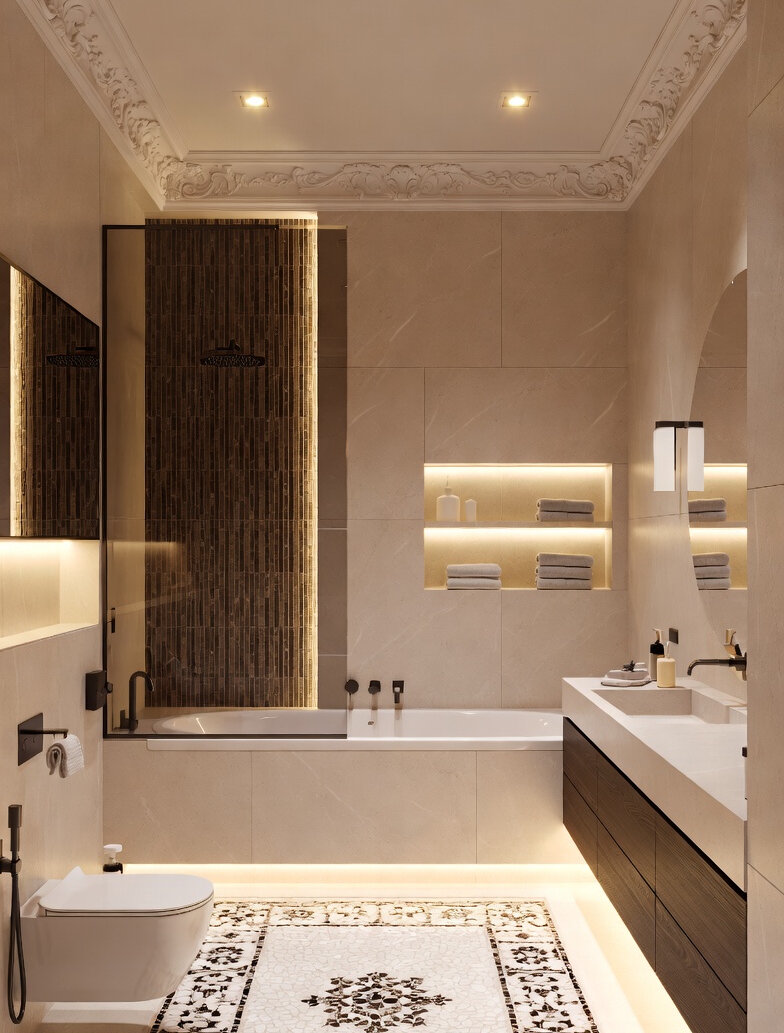
The contemporary classic bathroom takes inspiration from the past but lightens it, simplifies it, and makes it incredibly current. The moldings are there, but thin. The fixtures have soft but clean shapes. Decorative tiles don’t cover the whole bathroom, but become smart accents.
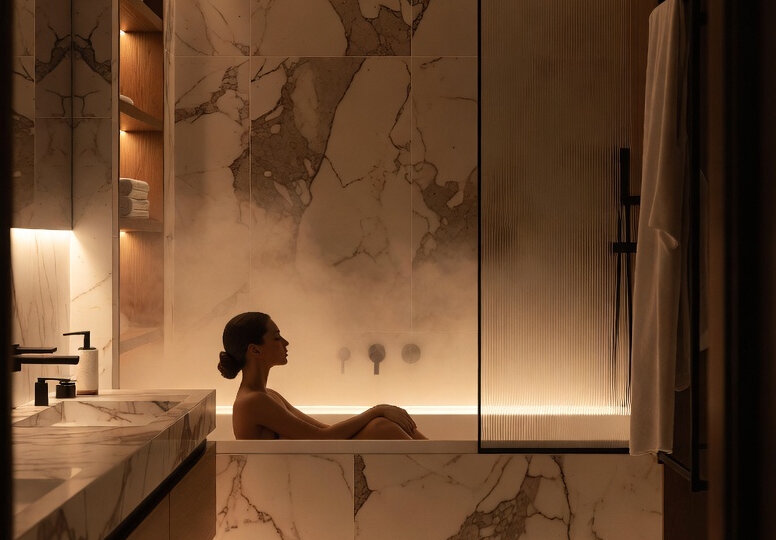
Marble is back in the spotlight, but no longer just glossy and pompous. Today it’s matte, veined, often paired with brushed, black, or bronze metals. The colors become deep: forest green, midnight blue, warm gray, ivory.
And do you know what’s the most interesting thing?
The classic bathroom today communicates solidity, durability, importance. In an era of disposable objects, choosing a classic bathroom is almost a revolutionary act. It’s saying: “This space matters. And I want it to still be beautiful in ten years.”
The real trend? Mixing (with taste)
And here comes the plot twist.
The real trend isn’t choosing between minimalist or classic. It’s blending them without being stopped by good taste.
A bathroom with a minimalist structure can have classic faucets.
A classic bathroom can have wall-hung fixtures and an ultra-modern walk-in shower.
A very clean space can be warmed up by wood paneling.
A decorative bathroom can become lighter thanks to essential lines.
What matters is not the style, but the coherence. The bathroom doesn’t have to follow a trend, it has to tell the story of who uses it. And above all, it has to work.
Because the bathroom is the only room in the house you use when you’re just awake, half asleep, in a hurry, angry, relaxed, tired, happy, and often with water splashing everywhere. If it’s not well designed, no style will save it.
Functionality: the trend that never goes out of style
This is where real experience comes into play, the kind that comes from well-done (and badly redone) renovations.
A trendy bathroom today must be easy to clean, moisture-resistant, well-lit, and above all comfortable. Showers are getting bigger, without useless steps. Shower trays are flush with the floor. Niches replace wobbly shelves. Lighting is no longer a single sad spotlight, but a carefully planned combination.
And then there’s the topic no one talks about but everyone experiences: space. Even a small bathroom can be minimalist or classic, if well designed. In fact, it’s often in small bathrooms that smart choices make the difference between “I don’t fit” and “how did I manage before?”
So: what should you really choose?
The truth is you don’t have to choose a catalog style. You have to choose a direction. Minimalist or classic are just two languages. What matters is how you speak them.
If you love order, light, simplicity, but don’t want to live in a cleaning product commercial, the new minimalism is for you.
If you love elegance, important materials, and a bathroom that “stands out,” contemporary classic is more current than ever.
If you love both, you’re perfectly in line with the best trends.
And above all, remember: the bathroom doesn’t have to impress guests once a year. It has to make your life easier every day.
The rest is just style. But the right style, if well designed, never gets old.
And if you’re thinking: “Okay, but where do I start?”, the answer is simple: with a well-done project. The perfect bathroom doesn’t come from a tile seen online, but from coherent choices, the right materials, and someone who knows how to tell you “no” when needed.
True luxury today isn’t choosing between minimalist or classic.
It’s not having to redo the bathroom in five years.