

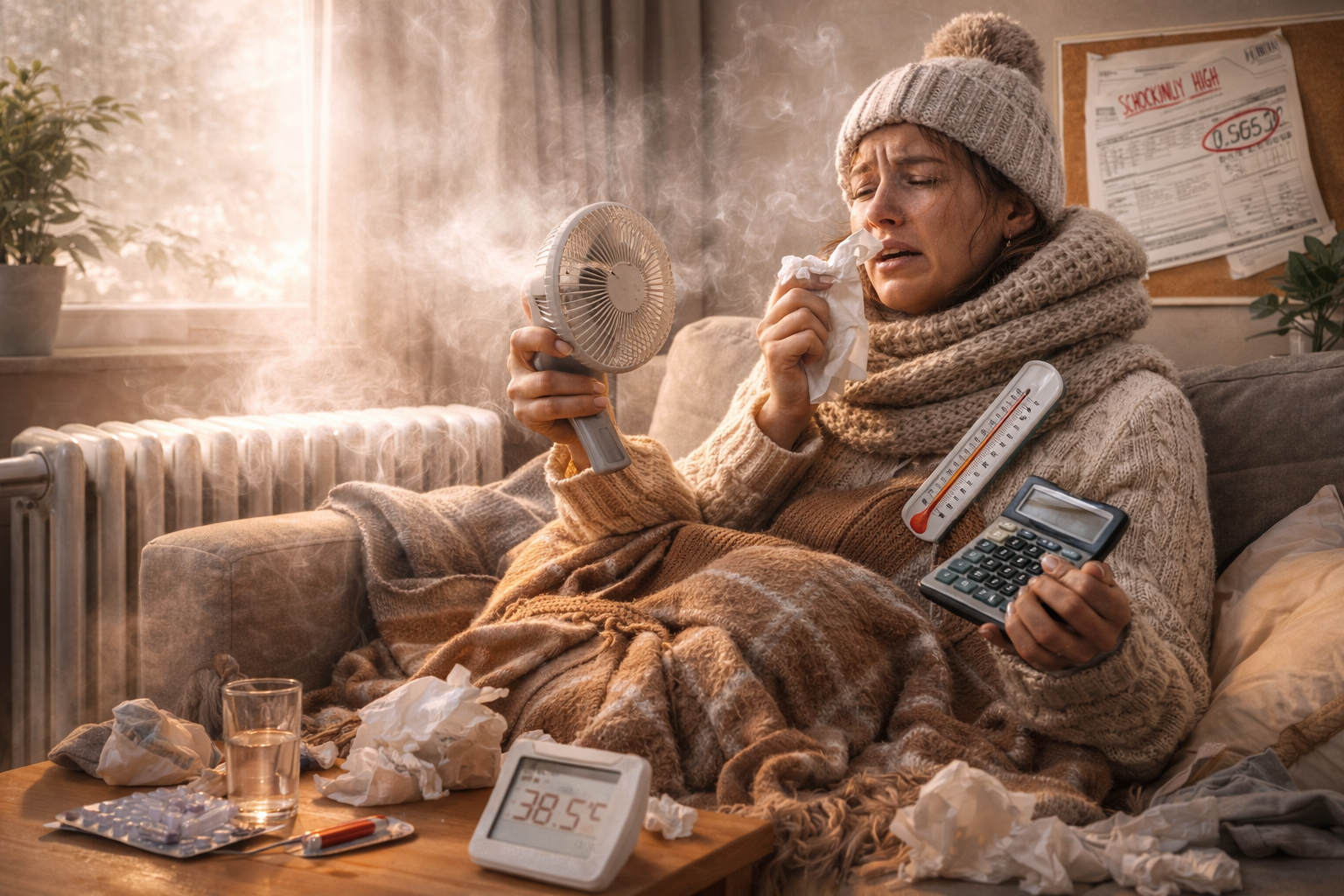
There’s a feeling we all know very well. You walk into your house in winter and it feels like stepping into a tropical greenhouse. You go out in the morning and in ten seconds you go from a down jacket to a t-shirt. In summer, it’s the opposite: outside it’s 38 degrees, inside the house it’s polar air like the North Pole, with the real risk of coming down with bronchitis in the middle of August.
And then we wonder why we’re always catching colds, tired, with a runny nose and a bill that rises like homemade bread during lockdown.
Spoiler: temperature swings are not inevitable. And no, it’s not “the crazy climate’s fault.” Very often they are the result of poorly used systems, houses that don’t help, and habits that sabotage comfort more than we imagine.
The temperature swing: the invisible enemy that follows you everywhere
A temperature swing is not just the shift from hot to cold. It’s the sudden and continuous difference between environments, surfaces, and air. It’s the body not having time to adapt, being stressed, and eventually paying the price: recurring colds, headaches, neck pain, chronic fatigue. And yes, even that feeling of “air getting into your bones.”
The absurd thing is that often we create these swings ourselves, with the best intentions. We turn on the heating “just to warm up a bit,” then turn it off, then turn it back on stronger. In summer we blast the air conditioning because “it’s hot,” only to turn it off suddenly because “it’s too cold.”
Result? The body goes crazy. And so does the system.
Why the house amplifies temperature swings (if it’s poorly built)
A house that isn’t properly insulated is a factory for temperature swings. Cold walls, windows that let heat escape, invisible drafts: everything contributes to creating different microclimates in the same room. You read 20 degrees on the thermostat, but your body feels 16 near the walls and 23 under the direct flow of the air conditioner.
That’s when you start playing with the knob as if it were a slot machine. You turn it up. You turn it down. You tweak it. You make everything worse.
The problem isn’t the set temperature, but the lack of stability. Real comfort isn’t feeling hot or cold, it’s not noticing the temperature at all. When you feel good without thinking about it, it means the house is working for you.
The big mistake: thinking that “stronger” means “better”
This is one of the most deep-rooted beliefs. Is it cold? We raise it by two degrees. Is it hot? Full blast air conditioning. It’s an instinctive reaction, but it’s exactly what creates the worst swings.
Modern systems are not designed to work in violent bursts. They’re made to maintain, not to chase. When you force them into constant regime changes, they consume more, work worse, and create those temperature differences that make you leave the house sweaty and come back shivering.
And the bill thanks you. But in a bad way.
Humidity: the secret ally of temperature swings
Here comes into play an aspect that almost everyone ignores: humidity. Because you can have the “right” temperature, but if the air is too dry or too humid, your body feels discomfort and reacts as if there were a temperature swing.
In winter, air that’s too dry accentuates the feeling of cold and irritates the airways. In summer, high humidity makes you sweat even when you’re still. And what do you do? You touch the thermostat again, creating a perfect vicious circle.
A house that manages air well is a house that drastically reduces swings, even without constantly changing the degrees.
Comfort is not instant: it’s continuous
One of the hardest things to accept is that comfort doesn’t just “turn on.” It’s built. Systems work better when they operate steadily, accompanying the day instead of chasing it. It’s a change of mindset even before a technical one.
When the house is well designed, properly insulated, and equipped with systems that work together, the temperature stays stable. No peaks needed. No constant corrections. No sweaters in the living room and tank tops in the kitchen.
And above all, the body stops suffering continuous shocks.
Fewer swings = fewer illnesses (and less money wasted)
Reducing temperature swings doesn’t just mean being more comfortable. It means getting sick less, sleeping better, being more focused and even more patient. And yes, it also means using less energy. Because a stable house always consumes less than a house managed with extremes.
The truth is that often you don’t need “more system,” but more intelligence in design and use. We need to stop thinking of temperature as a number to chase and start seeing it as a balance to maintain.
The conclusion no one says out loud
Temperature swings are not a fatality. They are almost always a symptom. Of a house that doesn’t work well, of systems not designed together, of bad habits passed down from generation to generation (“open the window to change the air” with the heating on, above all).
Avoiding them is possible. And when you succeed, you notice it right away. Not because you feel something different, but because you don’t feel anything anymore. No sudden cold. No drafts. No daily battle with the thermostat.
Just a house that does its job.
And a bill that, finally, stops making fun of you.