
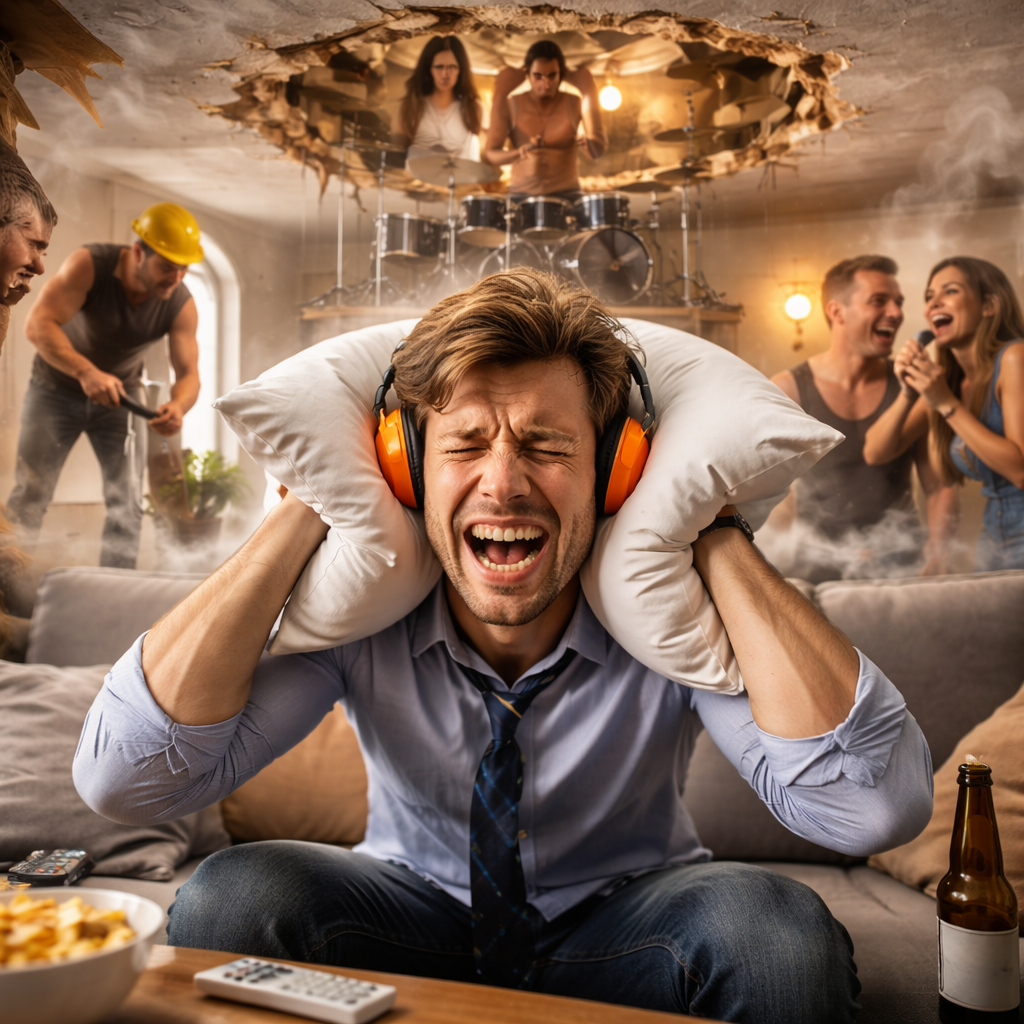

There are moments in life when you realize that soundproofing is not a luxury.
It’s survival.
The first comes when your neighbor decides to renovate their home.
The second when you discover that their child has started drum lessons.
The third when you realize that, apparently, someone upstairs walks exclusively in ski boots… even in August.
And that’s when a deep awareness is born: Italian walls often don’t separate homes.
They transmit sound experiences.
The great misunderstanding of modern homes
Many people think that noise is inevitable. That living in an apartment building means accepting a certain amount of acoustic chaos.
In reality, in most cases, the problem is not the noisy neighbor.
It’s the building.
For decades, homes have been built with almost exclusive attention to structure, aesthetics and — more recently — energy efficiency. Acoustics? Often treated as a secondary detail.
The result is plain to see (or rather, to hear): walls that let conversations through, floors that amplify footsteps, plumbing drains that sound like alpine waterfalls at night.
And no, it’s not normal to hear your neighbor sneeze.
Sound doesn’t pass through walls. It travels.
Here comes the first truth that surprises almost everyone.
Noise doesn’t just pass through a wall like light through a window. It vibrates, propagates, and exploits every available structural connection.
A knock on the floor becomes a vibration in the slab.
The vibration travels through beams and pillars.
And suddenly the noise appears in rooms that don’t even border the source.
That’s why you hear the neighbor on the third floor even if you live on the first.
It’s not magic. It’s building physics.
Why closed shutters and carpets aren’t enough
When noise becomes unbearable, the creative phase begins.
Heavy curtains.
Strategic bookshelves.
Carpets everywhere.
Giant paintings.
Solutions that provide psychological comfort… but rarely concrete results.
Furnishings can slightly improve internal reverberation, that is, the echo inside the house. But real soundproofing requires something different: interrupting the transmission of vibrations.
And this is where technical design comes into play.
The fundamental principle: separate, don’t thicken
Classic mistake: thinking it’s enough to make a wall thicker.
In reality, the secret of soundproofing is to create discontinuity.
A well-designed system doesn’t simply block sound: it decouples it. It prevents the vibration from passing directly from one structure to another.
This is the principle behind modern acoustic partition walls, where different materials work together to create an elastic barrier that absorbs and dampens sound energy.
In practice, the noise arrives… and loses strength along the way.
A bit like a WhatsApp argument after three days: it no longer has the same impact.
The real enemy: footstep noise
If voices are annoying, footsteps destroy mental serenity.
Impact noises — heels, dragged chairs, dropped objects — are the hardest to manage because they enter directly into the building’s structure.
Here, intervening on the walls is not enough. You need to work on the floors with under-screed insulation systems or floating floor solutions.
The concept is simple: the floor must “float,” avoiding rigid contact with the supporting structure.
When done correctly, the change is almost surreal.
The neighbor keeps walking.
But you stop knowing about it.
Beware of DIY acoustics
The internet is full of miraculous solutions.
Foam panels.
Egg cartons.
Unlikely adhesive foams.
Do they work?
Yes… in recording studios to control internal reverberation.
But against the neighbor’s noise, they are as effective as an umbrella during a hurricane.
Home soundproofing requires analysis of surfaces, acoustic bridges, lateral transmissions, and the frequencies involved. Without proper design, you risk spending money and only getting uglier walls.
And the neighbor will serenely continue their domestic percussionist career.
Even systems make noise (a lot)
One of the most underestimated aspects concerns systems.
Drains, risers, flush tanks, and air conditioning systems are often responsible for continuous and annoying noises.
The classic “water noise” at 2 a.m. is not cosmic bad luck: it’s a lack of vibration isolation.
Today there are specific decoupling systems and sound-insulating coatings that transform noisy pipes into almost acoustically invisible presences.
And suddenly you discover that silence really exists.
The legal side (the one everyone cares about)
Many people turn to soundproofing after considering the path of condominium disputes.
Warnings.
Arguments.
Passive-aggressive messages in the elevator.
The reality is that Italian law protects the right to rest, but proving that noise limits have been exceeded requires technical assessments, long timelines, and zen-like patience.
Intervening on the building envelope is often the quickest, most definitive and — paradoxically — least stressful solution.
In other words: instead of changing your neighbor, you change the behavior of sound.
And it’s infinitely simpler.
The true value of silence
Domestic silence is not just comfort.
It affects sleep, concentration, stress, and quality of life. More and more studies in the field of Building Acousticsshow how continuous exposure to noise increases mental fatigue and irritability.
In other words: you haven’t become intolerant.
You’re just tired of living inside a resonance box.
When you realize it was worth it
Those who carry out a soundproofing intervention often report the same experience.
The first night of silence feels strange.
Almost unnatural.
No footsteps.
No dragging noises.
No distant TVs.
Just calm.
And it’s at that moment you realize how much noise you were putting up with without even noticing.
Silencing the neighbor without arguing
Soundproofing isn’t about eliminating the sounds of the world. It’s about choosing which ones to listen to.
Your music.
Your conversations.
Your rest.
Because home should be the place where you recharge, not where you develop investigative skills to figure out who’s moving furniture at 11:47 p.m.
And the good news is that today there are effective, well-designed, and perfectly legal technical solutions to achieve what everyone wants but few really manage to have: the most underrated luxury of all.
Silence.
The real kind.