
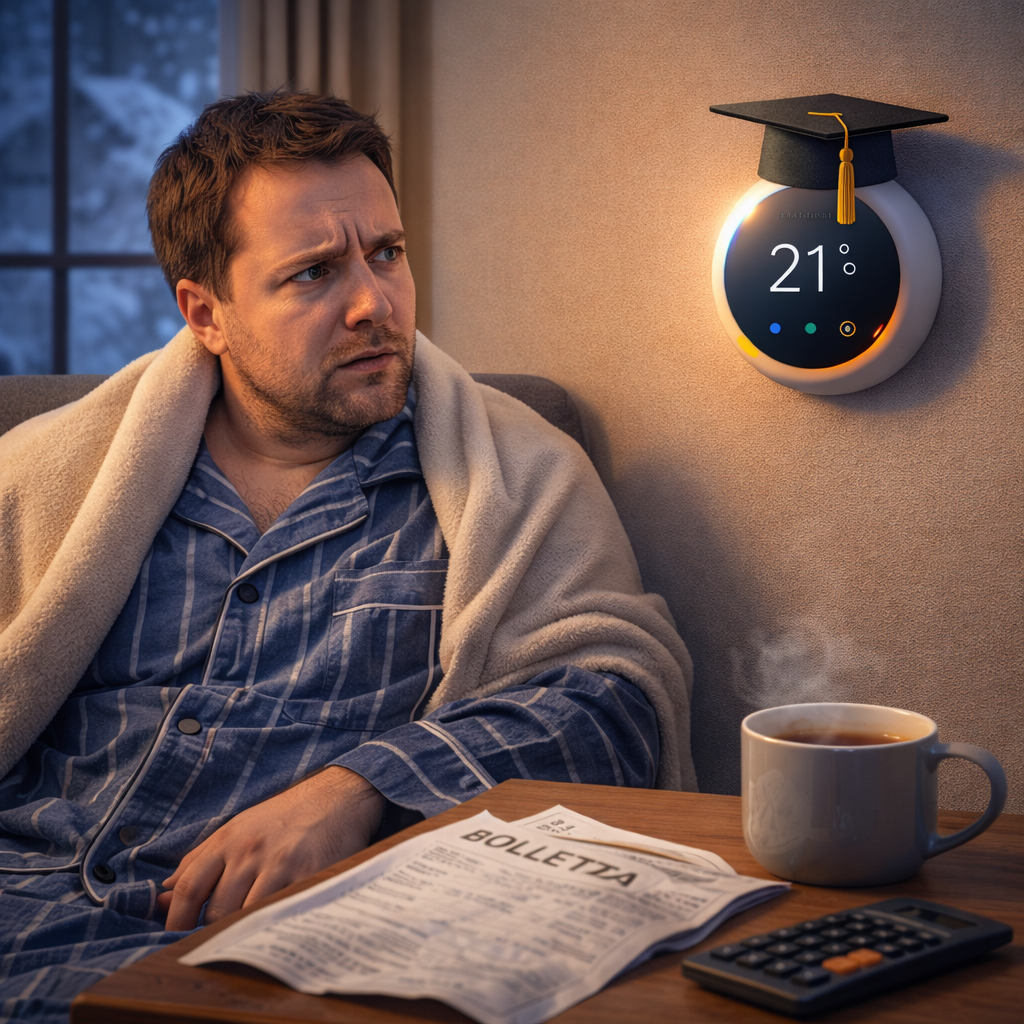
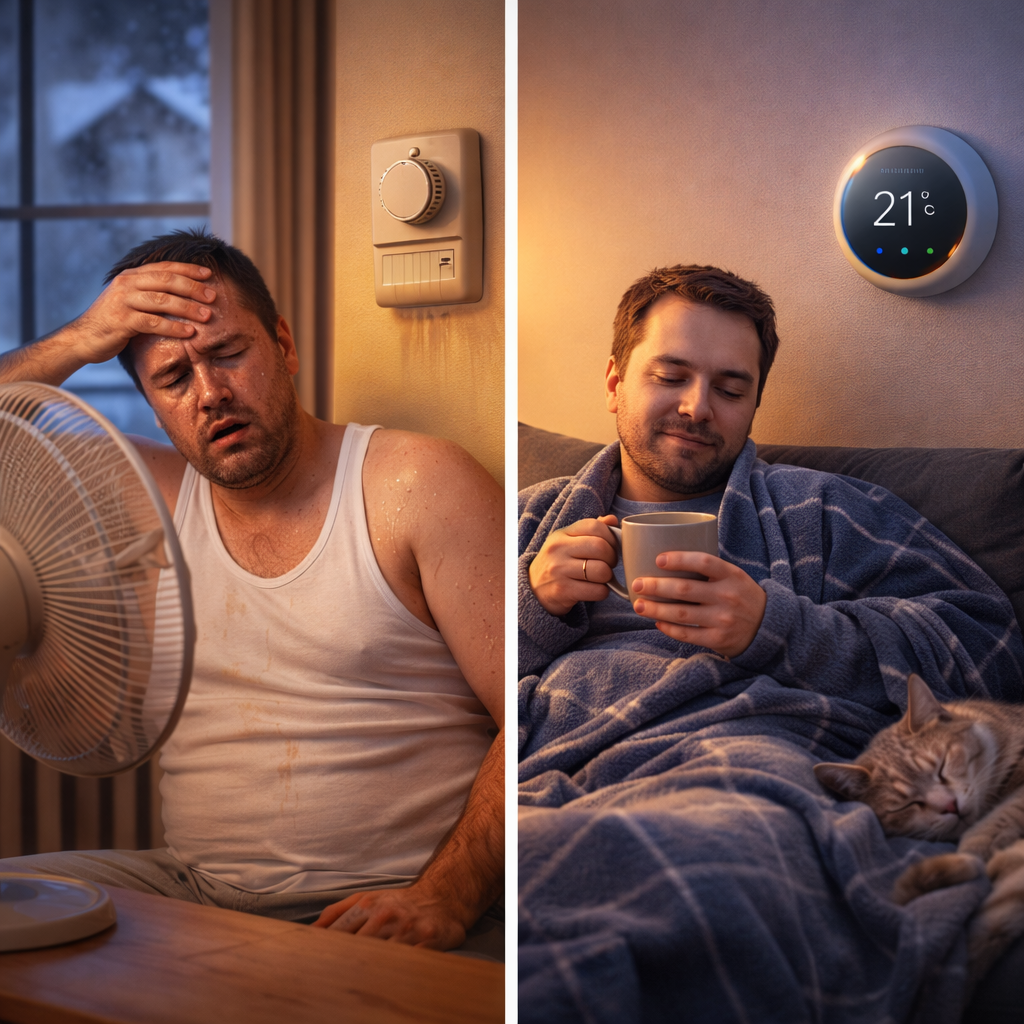
There is an object in Italian homes that for decades had a rather simple life.
The thermostat.
A small square on the wall with a dial or two buttons.
Its job was essential but not particularly brilliant: turn on the heating when it was cold and turn it off when it was hot.
End of story.
It didn't ask questions.
It didn't make decisions.
It had no ambitions.
Then, as happened with phones, televisions, cars and even vacuum cleaners, someone decided that it too could become... smart.
And so the smart thermostat was born.
An apparently tiny object that, once installed, manages to do something that many traditional systems can't do on their own: make the house run truly efficiently.
The big problem of Italian homes
Before talking about technology, we need to face a rather uncomfortable domestic truth.
Many homes are poorly heated.
Not because the system is faulty.
Not because the boiler is old.
But because the system is managed... by feeling.
There are those who turn on the heating at six in the morning "just in case."
Those who leave it on all day even if no one is home.
Those who turn it off completely and then turn it back on at full blast, turning the living room into a tropical greenhouse in twenty minutes.
The result is always the same: mediocre comfort and bills that look like they're out of a financial thriller.
And this is exactly where intelligence comes into play.
The thermostat that observes, learns and decides
A smart thermostat doesn't just measure the temperature.
It observes.
It analyzes how long it takes the house to heat up.
It understands how quickly it loses heat.
It studies the habits of those who live there.
Within a few days it starts to build a kind of behavioral map of the home.
If every morning at 7 someone enters the kitchen, it knows.
If on Saturdays the house stays empty until noon, it knows.
If the temperature drops faster when it's windy outside... yes, it knows that too.
It's not magic.
It's simply the application of the Internet of Things to home climate control.
The house that anticipates your moves
One of the most fascinating aspects of these systems is their ability to anticipate needs.
You no longer have to turn on the heating manually when you get home.
The house has already done it.
You don't have to turn it off when you leave.
The system has understood that no one is home and automatically lowers the temperature.
In some cases the thermostat even uses the smartphone's location to know when you're coming back.
Yes, the house knows you're coming.
And no, it's not creepy.
It's simply very convenient.
The savings that come from intelligence
The real advantage of smart thermostats is not convenience.
It's savings.
Home heating represents one of the main items of energy consumption in homes. And a surprisingly large part of that energy is wasted due to simple management inefficiency.
Turning on too early.
Turning off too late.
Heating unused rooms.
A smart thermostat eliminates much of this waste without asking you to change your habits.
It simply makes the system work in the most logical way possible.
And logic, when it comes to energy, almost always translates into money saved.
Even comfort changes completely
Those who switch from a traditional thermostat to a smart one often report the same feeling.
The house becomes more stable.
There are no more large temperature swings.
You no longer go from "too hot" to "too cold" in half an hour.
The system works more continuously and gently, keeping the environment always close to the ideal temperature.
It's a subtle but very noticeable difference.
A bit like going from an old car that accelerates in jerks to a modern car that glides silently on the asphalt.
The control that arrives on your smartphone
Another significant change concerns the way we interact with the home.
Thanks to dedicated apps, heating can be controlled from anywhere.
If you're at the office and the temperature suddenly drops, you can intervene with a simple gesture on your phone.
If you're on vacation and want to avoid heating an empty house for a whole week, it only takes a few seconds to change the schedule.
In practice, the thermostat becomes a small energy control center.
And the surprising thing is how quickly you get used to this convenience.
It's not just about heating
Many modern smart thermostats don't just manage the boiler.
They communicate with air conditioning systems, heat pumps and hybrid systems, coordinating the entire home's energy ecosystem.
In practice, they become the central brain of home comfort.
A role that until a few years ago was unthinkable for a device the size of a cookie box.
The most common mistake when installing
Despite all this technology, the success of a smart thermostat still depends on a very human factor.
Proper installation.
The temperature sensor must be placed in the right spot in the house. Not near heat sources, not directly exposed to the sun and not in hallways where the temperature doesn't really represent that of the lived-in rooms.
It seems like a trivial detail.
But a sensor in the wrong place can make even the world's most sophisticated thermostat make the wrong decisions.
When you realize you wouldn't go back
The moment when many homeowners realize the value of a smart thermostat usually comes during winter.
One evening you come home after a cold day.
You open the door and the temperature is perfect.
Not too hot.
Not too cold.
Simply right.
And at that moment you realize you did nothing to get that result.
The system worked on its own.
It turned on the system at the right time.
It modulated the power.
It avoided waste.
You simply... lived your day.
Small devices, big differences
In the world of home technology there are spectacular innovations that attract all the attention: photovoltaic systems, heat pumps, energy storage systems.
But sometimes the most surprising change comes from much smaller devices.
The smart thermostat is one of these.
A discreet, almost invisible object, yet it manages to do something fundamental: transform a traditional system into one that can think.
And when the house starts to think — at least a little — comfort improves, waste decreases and bills suddenly become less dramatic.
Not bad for a little square hanging on the wall.