
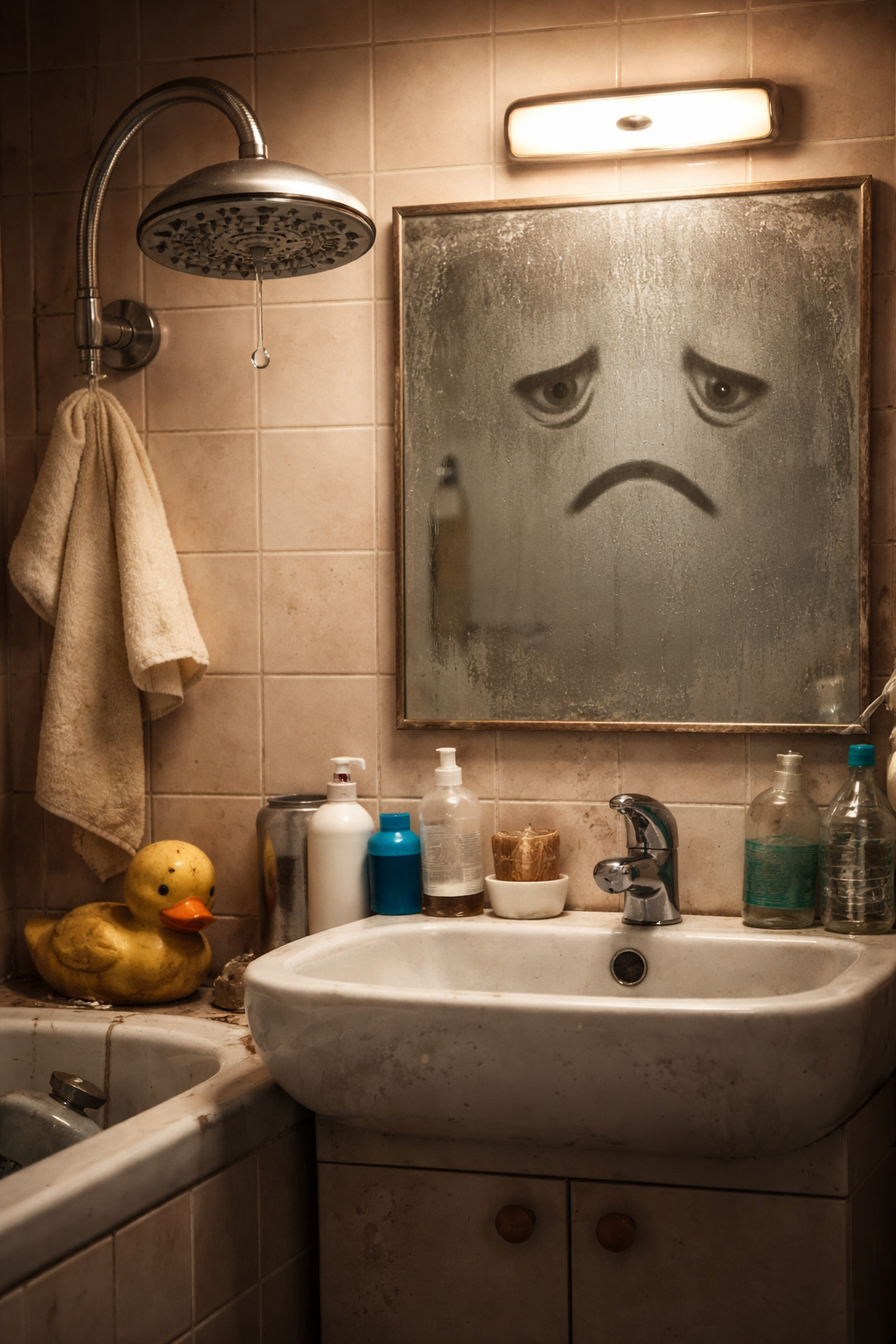
There’s a truth no one tells you when you buy a home or renovate: the bathroom is the first room to get depressed. Not the living room, which lives on guests and appearances. Not the kitchen, which always has an excuse to be chaotic (“I’m cooking!”). No. The bathroom is there—quiet, everyday, brutally honest. If something doesn’t work, you know right away. And it, without saying a word, takes on that… sad look.
You know the feeling? You walk in and it’s like you’ve crossed the threshold of a place that’s lost the will to live. Wrong lights, characterless tiles, an undefinable smell somewhere between “damp” and “meh,” a mirror that reflects more resignation than beauty. It’s not just an aesthetic issue: it’s an energy problem, a design problem, choices made because “it’s just the bathroom.”
That’s the point: precisely because it’s “just the bathroom,” it gets treated like the last in line. And that’s exactly why it becomes the saddest.
The bathroom isn’t a technical room (even if you treat it that way)
Many people design it as if it were a utility space: it has to work, period. Toilet, sink, shower. Done. The bare minimum to avoid breaking the laws of physics and civil coexistence.
Mistake.
The bathroom is the only space in the house where you’re truly alone. It’s where you start and end the day. Where you look yourself in the face without filters (literally and metaphorically). If that room is dull, cold, impersonal… it gives you back exactly that feeling.
A sad bathroom doesn’t happen by chance. It’s born from a series of micro-decisions made without vision:
“Let’s use these tiles because they cost less.”
“The light? Uh, a ceiling fixture and done.”
“Neutral colors, so we can’t go wrong.”
Spoiler: you went wrong.
The big misconception of “neutral = elegant”
The average Italian bathroom is a monument to beige. Light beige, dark beige, beige leaning gray, gray pretending to be elegant but actually just tired.
The problem isn’t neutral in itself. The problem is using it without character. Without contrast, without depth, without an idea.
A fully neutral bathroom is like someone who always dresses in gray “so they don’t mess up”: they don’t mess up, sure. But they don’t live either.
To make the bathroom “smile,” you need a choice. Even just one, but clear. It can be a bolder wall, a material with personality, a detail that breaks the monotony. You don’t need to turn it into a theme park, but at least give it a reason to exist.
Light: the silent mood killer
If your bathroom is sad, there’s a good chance it’s the light’s fault. Or rather, the total lack of lighting design.
A central ceiling light that illuminates everything flatly is the fastest way to turn the bathroom into an interrogation room. It enhances nothing, creates the wrong shadows, and makes you look even more tired than you already are.
Bathroom lighting should do three things:
guide you, flatter you, and not make you hate your own face in the morning.
You need layering. A general light, yes, but also a dedicated mirror light, ideally from the front and not from above (unless you want to look like a villain in a horror movie). And maybe a softer, indirect light for when you don’t need surgical precision—just a moment of peace.
A well-lit bathroom doesn’t become happier by magic. But it stops looking chronically depressed.
Materials: when “practical” becomes “sad”
“Let’s choose something durable, easy to clean.”
Right. But often that sentence becomes the excuse to pick soulless materials.
The bathroom is one of the rooms where touch matters as much as sight. Surfaces that are too cold, too artificial, too uniform… create distance. They don’t invite. They don’t welcome.
It doesn’t mean you have to redo everything in Carrara marble or tropical solid wood. It means choosing at least one element that adds warmth or depth: a texture, a matte finish instead of glossy, a contrast between smooth and tactile surfaces.
A sad bathroom is one where everything is “perfectly correct” but nothing is interesting.
Emotional clutter (on top of the real kind)
Let’s be honest: the bathroom is the kingdom of disguised chaos. Bottles, little bottles, products started and never finished, objects you’re not sure why still exist.
And no, it’s not just an aesthetic issue. Visual clutter creates a sense of heaviness. The bathroom becomes crowded, stifling, confusing.
A happy bathroom isn’t necessarily minimalist. But it’s organized. It has logic. Things have a place, and that place makes sense.
Often it’s enough to rethink storage: smarter cabinets, integrated solutions, a few drastic choices (“I’m actually throwing this out”). And suddenly the bathroom breathes. And with it, you do too.
Smell: the detail that gives everything away
You can have the most beautiful bathroom in the world, but if you walk in and catch that indefinable smell… you’ve lost.
Smell is the first emotional impact. And it’s often tied to ignored technical issues: insufficient ventilation, humidity, imperfect drains.
A sad bathroom is often a bathroom that doesn’t breathe. And if it doesn’t breathe, sooner or later it “speaks.” And what it says is never pleasant.
Here you don’t need tricks or aggressive air fresheners. You need to fix the root cause: proper ventilation, materials that don’t trap moisture, well-designed systems.
Any fragrance, if it comes, should be a consequence. Not a cover-up.
A happy bathroom exists (but it’s not what you think)
A bathroom that “smiles” isn’t necessarily big, expensive, or magazine-worthy. It’s a coherent bathroom. Thought through. Cared for.
It’s a bathroom you enter and don’t feel like you’re in a pass-through place, but in a space with its own identity. Even small, even simple, but clear.
It’s the one where light helps you instead of sabotaging you. Materials accompany you instead of pushing you away. Objects are few, but right. And everything seems to make sense.
And you know what’s interesting? It’s not a budget issue, but a choices issue. You can spend a lot and end up with a very sad bathroom. Or spend smart and create a space that truly works.
The final truth (that you may not want to hear)
If your bathroom is sad, it’s probably not the bathroom’s fault.
It’s because you treated it as something secondary.
You decided it didn’t deserve attention, vision, care. You thought “as long as it works.” And it took that instruction literally: it works. But it doesn’t live.
The good news is you can change things. It doesn’t necessarily take a full renovation. Sometimes targeted interventions are enough, more conscious choices, a project—even a small one—done with sound criteria.
The bathroom isn’t asking you to become a designer. It’s only asking you to stop ignoring it.
And when you start treating it for what it really is—a daily, intimate, essential space—something interesting happens: it stops being sad.
And yes, it starts smiling too.