

There’s an unwritten rule in Italian homes: as long as the light turns on, everything’s fine.
It’s one of those comforting beliefs, like “I’ll start the diet tomorrow” or “this crack is just cosmetic.” The problem is that an electrical system doesn’t run on perception. It runs on conditions. And when those conditions start to worsen, it doesn’t send push notifications. It sends signals. More or less obvious.
The point is that electricity is invisible. You don’t see it, you don’t feel it (unless something really goes wrong, and then it’s already too late), so you tend to forget it exists. Until it decides to remind you in the least elegant way possible.
And no, you don’t need to get to the spectacular short circuit with Hollywood sparks. Long before that, the house warns you. It just does it discreetly. And we, as always, are great at ignoring discreet things.
When “the power trips sometimes” isn’t household folklore
Let’s start with a classic.
“Every now and then the breaker trips.”
Said with a lightness that deserves an award.
The truth is, a properly sized electrical system doesn’t “trip sometimes.” If it happens, there’s a reason. And the reason is rarely “just because, for fun.”
It could be an overload, sure. But it can also mean the system is no longer suited to today’s consumption. Because let’s be honest: homes from twenty years ago weren’t designed to handle, at the same time, an oven, an induction hob, an AC unit, a washing machine, and maybe even charging an electric car.
So no, it’s not bad luck. It’s a signal.
Outlets that do weird things (and no, it’s not being friendly)
Another great classic: the outlet that works “if you touch it the right way.”
Or the one that gets warm. Or the one that makes a little “tick” when you plug something in.
Here we enter territory where irony ends and caution begins.
An outlet that behaves oddly isn’t a whim. It’s a critical point in the system. And critical points, in electricity, have an interesting trait: they get worse.
Heat, in particular, is a sign you shouldn’t downplay. Because it points to resistance, imperfect contacts, leakage. And all these things share one talent: turning into serious problems.
Lights that “set the mood” when you didn’t ask them to
You know when a bulb starts to flicker? Or the light dips slightly when you switch on an appliance?
Many people find it almost charming. A bit vintage. A bit like a ’70s movie.
Too bad it’s not a special effect.
Changes in brightness indicate instability in power distribution. It could be a line issue, a connection problem, a poorly balanced load.
It’s not necessarily serious right away. But it’s a symptom. And symptoms, if ignored, evolve.
The electrical panel: that mysterious object nobody ever opens
The electrical panel is a bit like the brain of the house. Except that, unlike the human brain, it gets systematically ignored.
Many people don’t even know what’s inside. And above all, they don’t know whether it’s up to date.
If you still have old-style fuses, if there’s no proper RCD, if there’s no clear organization of the circuits… you’re looking at a system that has probably seen better days.
And this isn’t about looks or convenience. It’s about safety.
The “old-school” system (that used to be just fine)
There’s a certain nostalgia for things made “like they used to.” In some cases it makes sense. In electrical systems, much less.
A system from 25–30 years ago may have been built perfectly… for the needs of that time.
The problem is that needs have changed. A lot.
Today we consume more, in different ways, and with more sensitive devices. An old system can cope, yes. But often it does so at the limit. And living at the limit, with electricity, isn’t exactly relaxing.
The “small temporary fixes” that become permanent
Here we enter the realm of household creativity.
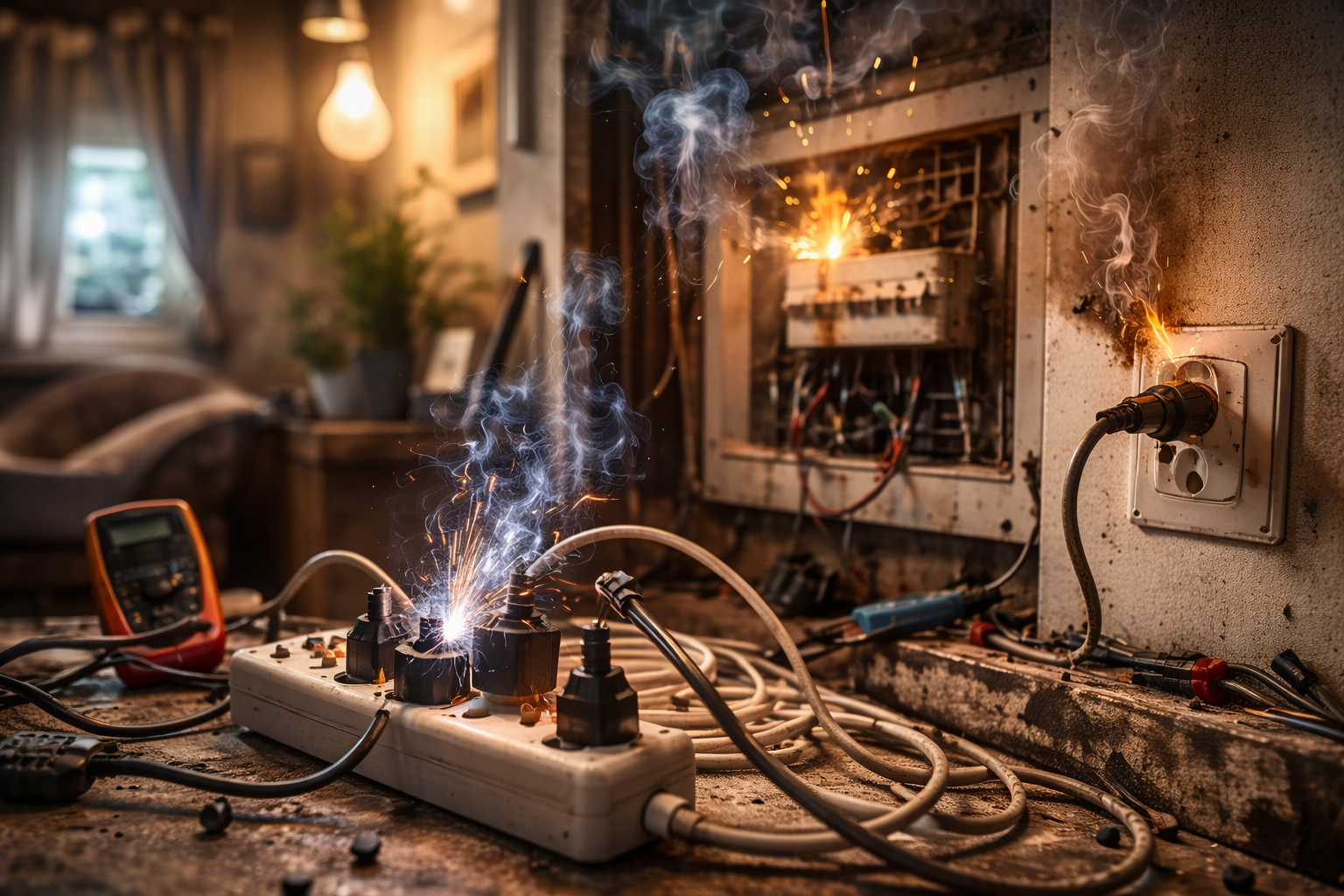
Extension cords everywhere. Power strips linked together like a wrong evolutionary chain. Adapters that look like they came out of an experimental lab.
Everything works. More or less.
The problem is these solutions start out as temporary. Then they become permanent. And in the meantime, the load on the system grows in a messy way.
The result? A system that works, yes, but without any real control.
The smell of burning (which is never a good sign)
If you smell plastic or overheated cables, it’s not an invitation to reflect. It’s an invitation to act.
Immediately.
This is one of the few signs that leaves no room for interpretation. Something is working badly. And when electricity works badly, it doesn’t stay harmless for long.
Ignoring it is a terrible idea. Taking action is the only sensible one.
The real problem: not knowing what your system is really like
If you had to answer this question: “What condition is your electrical system in?”, what would you say?
If the answer is “uh, it works,” you’re average. But you’re not in control.
And that’s the point.
The problem isn’t having an old system. It’s not knowing how old it is, how it was built, whether it’s been updated, whether it fits your current needs.
Because without that information, every decision is random.
When to act (without waiting for the worst moment)
There’s a common belief: you act when something breaks.
It’s an understandable strategy. But inefficient.
Acting earlier means more options, more control, more chance to do things calmly and properly.
Acting later means rushing. And when you rush, you make mistakes more easily. And you spend more.
You don’t need to redo everything no matter what. You need to understand.
A system check, done by someone who knows where to look, gives you a real snapshot. And from there you can decide.
The final truth (not flashy, but it works)
The electrical system is one of those things that works best when you don’t think about it. But precisely for that reason, you need to think about it sooner.
Waiting for the obvious problem is convenient. But it’s rarely cost-effective.
The house sends you signals. Here too. Even about the electrics.
The difference between a small planned fix and a sudden serious problem is all there: in the attention you give it while it’s still the right time.
Because yes, as long as the light turns on it seems everything’s fine.
But that’s not the real test.