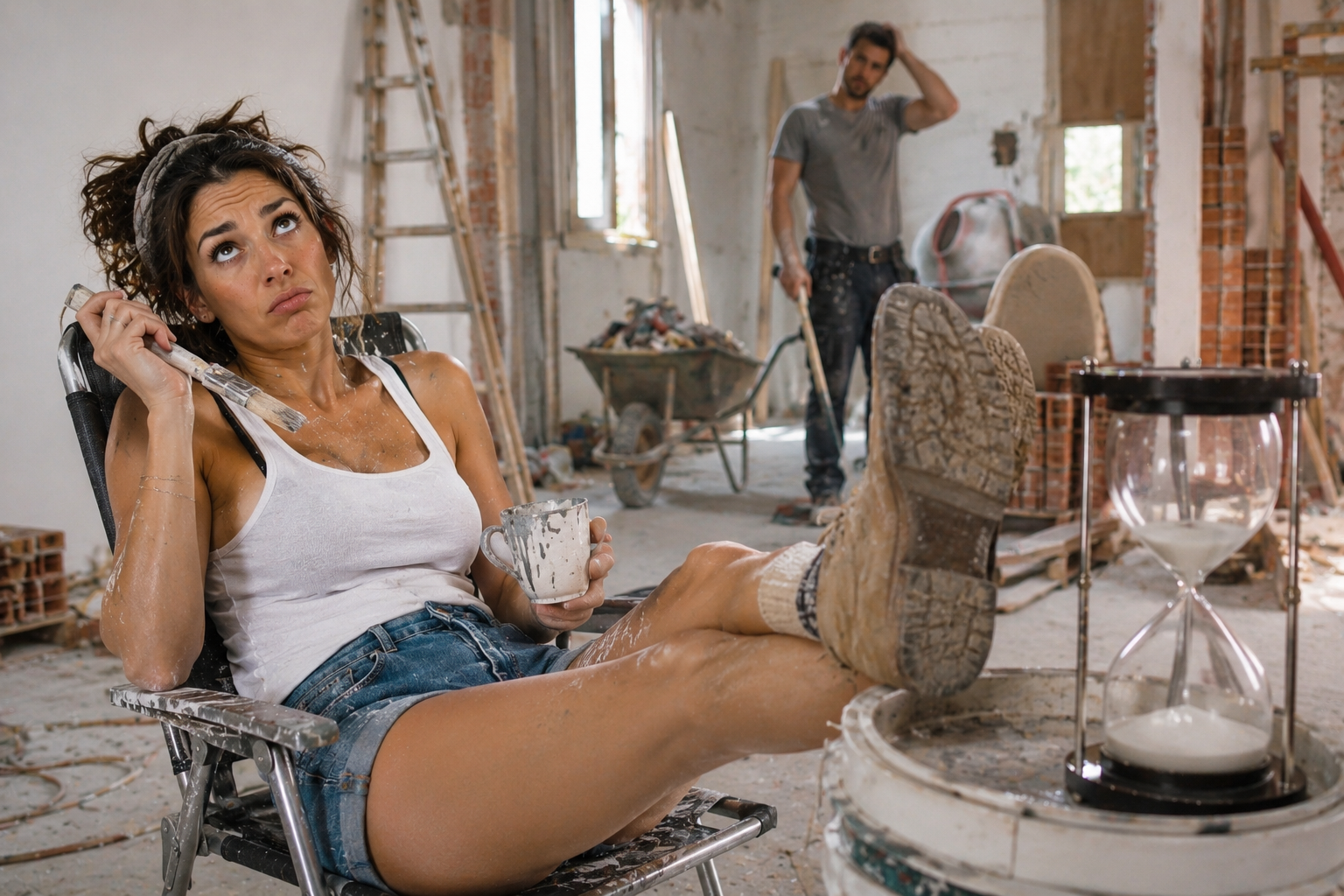


There’s a precise moment, in every homeowner’s life, when everything seems possible. It’s that moment when you look at your salmon-colored ’80s bathroom and think: “Come on, how much could it ever cost to redo it?”
Spoiler: far more than they’ll tell you at the start. And above all, far more than you imagine.
Because the real problem with renovations isn’t the cost itself. It’s the illusion of the cost. That neat, reassuring figure they give you at the first meeting. The one that makes you think you’ve got everything under control.
And yet, no. That figure is just the entry fee. The basic ticket. No luggage, no assigned seat, not even the certainty you’ll reach your destination.
The truth is there’s a series of “invisible” costs that aren’t scams, aren’t mistakes, but simply reality. The problem is that nobody explains them clearly at the beginning. So you set off convinced you’ll spend X… and you calmly end up at X + 30%, if you’re lucky.
So let’s look, with no filters and a bit of healthy cynicism, at the seven cost items that will follow you — whether you like it or not — during your renovation.
The first item is the one that hurts your ego the most: surprises.
There’s no renovation without surprises. If someone tells you otherwise, they’re selling something — and it isn’t honesty.
You open a wall and find an electrical system made by a conceptual artist from the ’70s.
You move a tile and discover there’s more damp underneath than in a tropical rainforest.
You demolish a partition and realize it was carrying more than it should have.
These aren’t unlucky cases. They’re the norm.
The point is that surprises aren’t optional. They’re structural. And yet, they’re rarely written into the initial budget with the dignity they deserve. They should be treated as a real cost item, not a last-minute shock.
If you haven’t planned for them mentally (and financially), you’ll pay twice: in money and in nerves.
Then comes design. The kind done properly.
At first it seems like an avoidable expense. “Come on, I already know what I want.”
Sure. Of course.
Design is one of those things that, if done well, you don’t see. If done badly, you pay for it every day for the next twenty years.
We’re talking space layout, natural light, functionality, ergonomics, systems. It’s not just “where do we put the sofa,” but how you’ll live in that home.
And this work has a cost. A cost that’s often underestimated or cut to “save money.”
It’s a false saving. Because bad design creates mistakes. And mistakes, in construction, aren’t fixed with an eraser. They get demolished. And then redone.
The third item is the one everyone ignores until it’s too late: paperwork.
Welcome to the wonderful world of permits, authorizations, notices, certifications and documents that nobody will ever truly read to the end.
Every intervention has its own regulatory framework. And every framework has costs: technical, administrative, municipal.
They’re not “extra” costs. They’re mandatory.
And no, it’s not just about paper. It’s about responsibility.
If something isn’t done correctly, the consequences come. Maybe not right away, but they come. And usually at the worst moment, like when you want to sell the house or apply for a mortgage.
Fourth item: compliance upgrades.
This one is sneaky. Because you start with the idea of “redoing,” and you end up having to “bring up to code.”
Bring systems up to current regulations.
Bring heights, ventilation, heat loss up to standard.
Bring everything that, until yesterday, worked… but today is no longer compliant.
The point is simple: your home was built in a different era. The rules have changed. And when you touch something, you’re often required to align with the present.
That means extra costs. Non-negotiable.
The fifth item is the most dangerous: changes during the works.
This one is entirely your fault. And yes, it’s fair to tell you.
At the start you have clear ideas. Then the work begins. Then you see the spaces “in real life.” And suddenly you start saying things like:
“Since we’re at it…”
“What if instead we…”
“Come on, it’ll only take a second…”
It’s never “a second.”
Every change during the works has a domino effect: timelines stretch, tasks change, materials must be reordered, crews rescheduled.
And every time you say “since we’re at it,” your budget takes a little leap into the void.
Sixth item: finishes. The ones that make you fall in love (and spend).
Here you enter emotional territory.
Because as long as we’re talking screeds and systems, you’re rational. Then you walk into a showroom.
And something happens there.
The flooring you’d budgeted at €30/sqm suddenly looks… sad.
The basic tap becomes “a bit anonymous.”
The standard door… well, you’re past that now.
Finishes are where the project becomes a home. And it’s also where the budget explodes with elegance.
There’s nothing wrong with wanting to choose well. But you need to be aware that every upgrade has a real cost. And it’s often underestimated.
Finally, the seventh item: time.
It doesn’t look like a cost. But it is.
Time lost coordinating, deciding, chasing suppliers, handling problems.
Time when you maybe can’t live in the house.
Time that impacts work, family, patience.
And when the works drag on — because they do — this cost grows.
Time is the most underestimated and most devastating variable. Because you can’t get it back. You can only endure it… or manage it better from the start.
So, what should you actually do before you start?
You don’t need to become a construction expert. You need to become clear-headed.
Accept that the initial cost won’t be the final cost.
Demand transparency, but above all prepare yourself mentally for a gap.
Surround yourself with professionals who also tell you what you don’t want to hear, not only what reassures you.
And above all, stop seeing renovation as an expense to squeeze at all costs. It’s an investment.
And like all investments, it can be done well… or it can become a very expensive lesson.
The difference isn’t luck.
It’s the awareness you start with.
Because in the end, there’s only one truth:
everyone pays those seven cost items.
The difference is whether you discover them before… or while you’re already signing yet another extra.