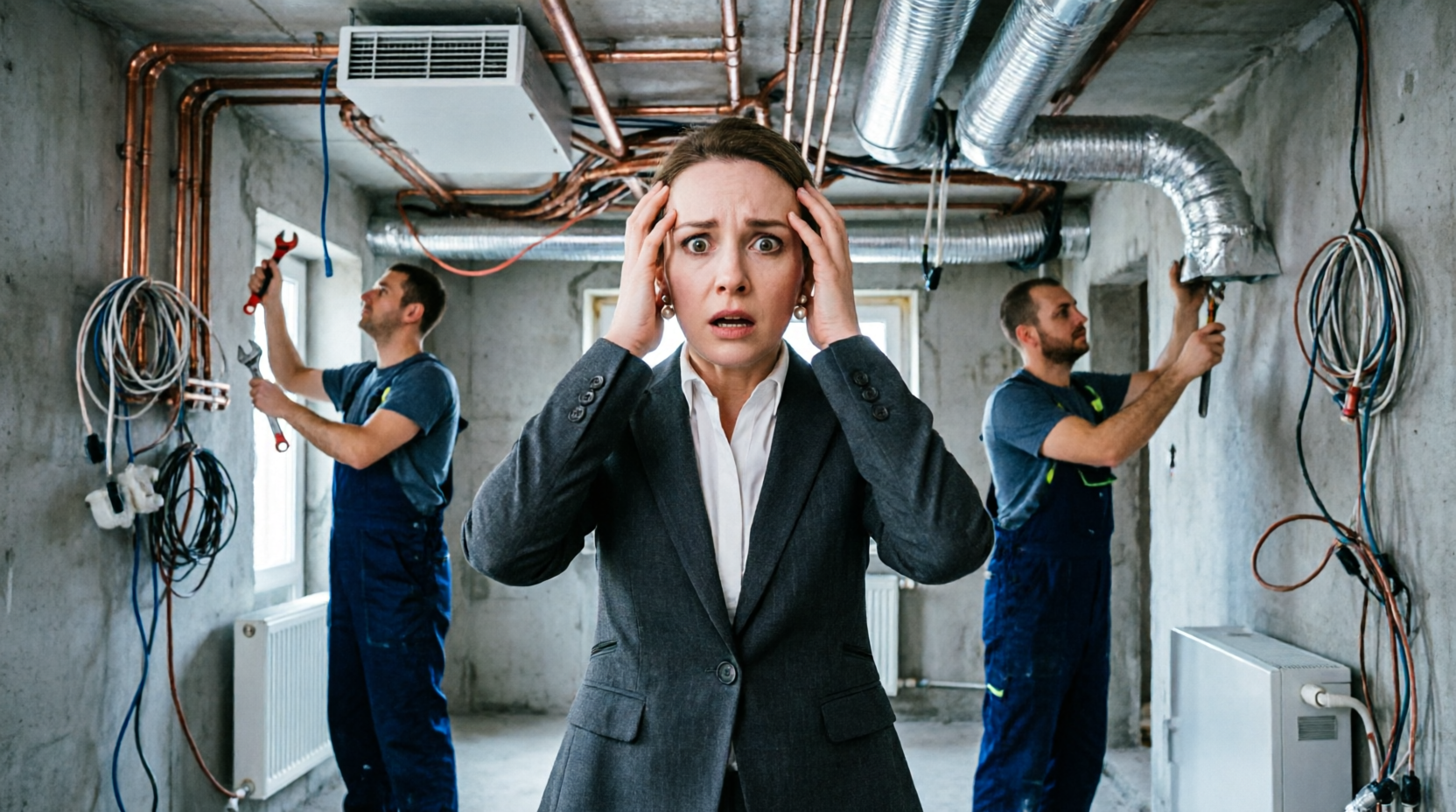


There’s a phrase that, in the world of renovations, sounds like an ancient curse, passed from site to site, whispered through clenched teeth by those who’ve been there:
“We’ll redo it.”
Two words. Eight letters. A devastating meaning.
Because when a job gets redone, you’re not simply fixing a mistake. You’re paying twice. Sometimes three times. And often, along with the money, you also leave behind time, peace of mind, and a fair amount of faith in humanity.
This article isn’t a list of good intentions. It’s a blunt X-ray — and yes, ironic too — of what happens when you save in the wrong place, when you choose without criteria, or when you underestimate the complexity of a home renovation.
Because the truth is simple: in construction, bad work is never cheap. It’s only cheap at the start.
The myth of “it’s easy anyway”
Every disaster starts like this.
“Come on, it’s just a bathroom.”
“It’s just a partition wall.”
“It’s just redoing the systems.”
That “just” is the first danger sign.
A renovation, even the simplest one, is a complex system. There are structures, systems, regulations, work sequences. Every intervention is linked to the others. Every mistake spreads.
The problem is that this complexity can’t be seen. Until something breaks.
And when it breaks, it never breaks alone.
Story number one: the most expensive bathroom in the neighborhood
Let’s start with an evergreen classic: the bathroom redone “at a good price.”
The client finds a company offering an unbeatable quote. So low you almost feel smart accepting it. “Look how much I saved.”
Work starts. Everything seems to move fast. Too fast.
Tiles laid in record time. Systems “sorted out.” Fixtures installed. Job done. All nice. Photos on WhatsApp. Applause.
Three months later: leaks.
Not a romantic drip. A serious situation. Mold, smells, water going where it shouldn’t. The cladding fails. It gets opened up. And that’s when the truth arrives.
No waterproofing.
Wrong slopes.
Drains installed “by feel.”
Result? Everything gets demolished. Again.
The cheap bathroom becomes the most expensive bathroom in the neighborhood.
And here an interesting psychological dynamic kicks in: the client doesn’t pay only to redo it. They also pay to dispose of what was done badly. They pay to go backwards.
It’s the most ignored concept in renovation costs: a mistake isn’t corrected, it’s erased. And erasing costs.
A low price isn’t a competitive advantage
Here we need to be brutal: if a quote is much lower than the others, you didn’t find a bargain. You found a problem.
There are no miracles in construction. There are materials, labor hours, skills.
If the price drops too much, somewhere something disappears.
And no, it’s not margins that disappear. It’s quality.
Time spent can disappear.
Care for details can disappear.
Real competence can disappear.
Accountability can disappear.
And when these things disappear, the jobsite becomes a ticking time bomb.
Story number two: the “creative” electrical system
Another great home-renovation classic: the electrical system redone “on the cheap.”
The client wanted to save money. The electrician, very accommodating, agreed.
Chases cut quickly. Wires pulled. Connections arranged. Everything works. Apparently.
Then the small signs begin.
Lights flickering.
Outlets heating up.
The breaker tripping for no reason.
Until one day it’s no longer an annoyance. It’s a risk.
A serious technician comes in. Runs checks. And the verdict is clear: system to be redone.
Not to be patched. To be redone.
Because when a system is designed badly, it isn’t reliable. And when it isn’t reliable, it isn’t safe.
And here the cost doubles. Because redoing an electrical system in a finished home means breaking walls, removing finishes, creating huge disruption.
Saving at the start turns into multiplied spending.
The real problem: you don’t see it right away
If you buy a defective piece of furniture, you notice.
If you buy a phone that doesn’t work, you see it.
On a jobsite, no.
Bad work can look perfect for months. Sometimes years.
That’s why so many mistakes go unnoticed at first. And when they surface, the damage is already widespread.
Renovation isn’t a product. It’s a process.
And the quality of the process shows… over time.
Story number three: the floor that “sounds”
This one is almost poetic.
Renovated home. New floor. Beautiful. Wow effect.
Then you start walking on it.
Tap.
Tap.
Tap.
The floor sounds hollow.
It shouldn’t.
That sound is the sign of a problem underneath. Uneven screed. Adhesive applied badly. Tiles laid without method.
At first it’s just annoying. Then come cracks. Then debonding.
And there’s no elegant fix. You break it up. You redo it.
And redoing a floor means dismantling half the house.
The culture of “it’ll hold”
One of the biggest enemies of quality in construction is this mindset: “it’ll hold”.
It holds today.
It holds tomorrow.
It holds until it doesn’t anymore.
The problem is that a house isn’t made to “hold.” It’s made to work well, safely, and over time.
When you work with the bare minimum, you build something with no margin. And it takes very little for everything to collapse.
Story number four: the shower that floods the living room
Here we enter tragicomic territory.
Modern renovation, open space, elegant bathroom.
Walk-in shower, flush with the floor. Gorgeous. Magazine-worthy.
Too bad the slope was wrong.
Every shower became a controlled migration of water toward the living room.
At first you dry it up. Then you try to “manage” it. Then you accept it. Then you lose your mind.
And finally you redo it.
Because certain mistakes can’t be fixed with a patch. They can only be corrected by starting over.
The invisible cost: stress
Let’s be clear.
Redoing a job isn’t only an economic issue.
It’s lost time.
It’s life on hold.
It’s mental energy burned.
Every problem on site has a real impact on your daily life.
Phone calls. Arguments. Forced decisions. Delays.
When a job is done well, you barely notice.
When it’s done badly, it becomes the center of your life.
And that has a huge cost, even if it doesn’t appear in any quote.
The role of professionals (the real ones)
There’s a huge difference between someone who “does jobs” and someone who manages a renovation.
The first executes.
The second thinks, coordinates, prevents.
A good professional isn’t the one who costs less. It’s the one who keeps you out of trouble.
And that value is hard to perceive at the beginning. Because prevention can’t be seen.
But when something goes wrong, the difference becomes obvious. Very obvious.
Story number five: the thermal coat… punctured
Energy-efficiency upgrade. External insulation. Promises of savings.
Work done quickly. Everything looks perfect.
Then the first cold weather arrives.
Cold spots. Condensation. Mold.
Analysis: insulation installed badly. Thermal bridges ignored. Materials used without criteria.
Result? Zero performance.
And redoing insulation isn’t like changing a curtain. It’s a major, costly, invasive intervention.
The point nobody wants to accept
Renovating costs.
And it costs because it requires skill, time, and responsibility.
If you try to squeeze the cost too much, you’re not optimizing. You’re removing foundations.
And foundations, sooner or later, send the bill.
How to avoid all this (without illusions)
There’s no perfect renovation.
There’s the one managed well.
You must accept that spending less at the start often means spending more later.
You must choose based on value, not price.
And above all you must understand one thing: you’re not buying a job. You’re buying a result over time.
The final truth (the one nobody puts in the quote)
Every euro saved the wrong way is a euro that will come back to charge you interest.
Bad work is never a bargain. It’s a down payment on a future problem.
And when that problem arrives, it doesn’t negotiate. It doesn’t discount. It doesn’t accept excuses.
It asks you for only one thing: redo everything.
And at that point, the question is no longer “how much does it cost?”
But “why didn’t I do it right the first time?”
If there’s one thing you should take away from this article, it’s this:
In construction, quality isn’t a luxury.
It’s the only real saving possible.