
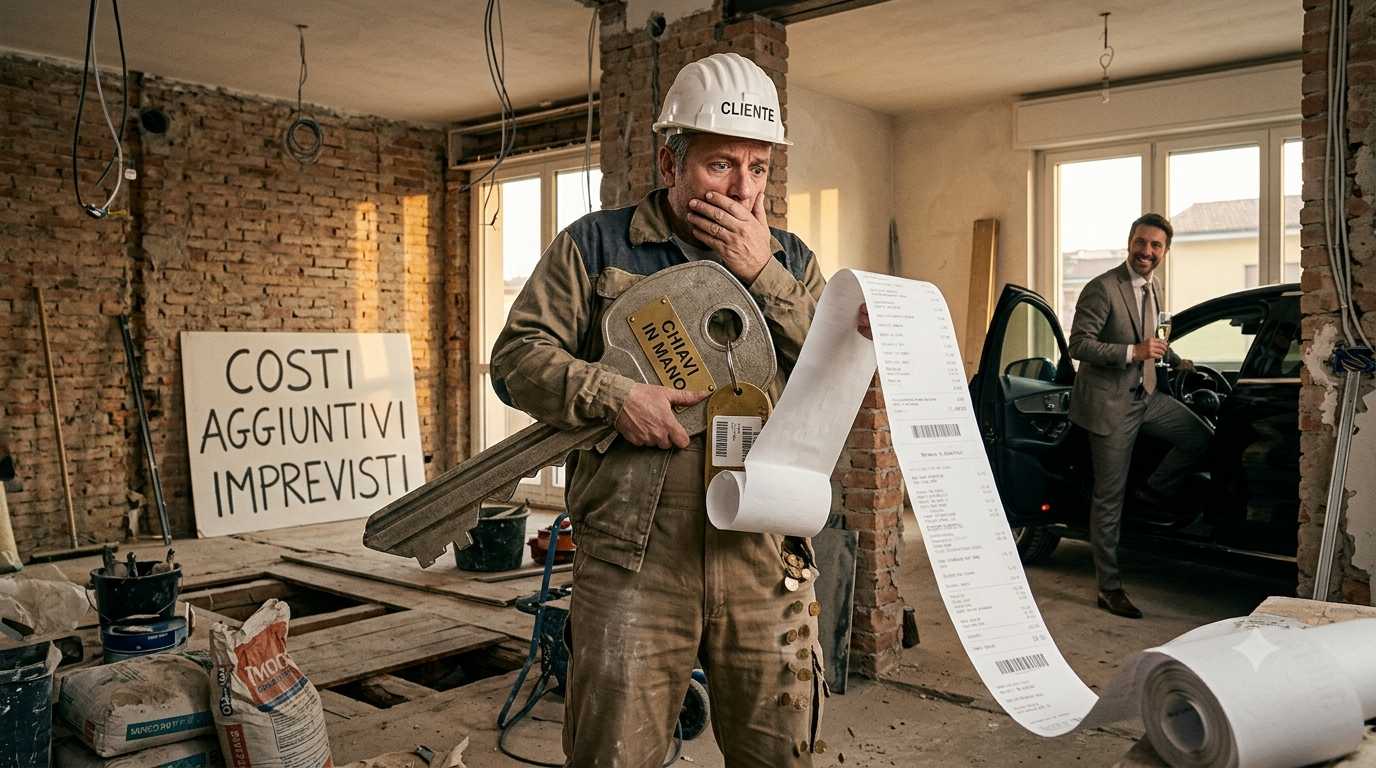

The client’s forbidden dream: leave for vacation and come back to the home of your dreams
There’s a recurring fantasy shared by almost everyone who decides to renovate their home. It’s an idyllic image, almost like a TV commercial. You hand your house keys to a smiling, reassuring company. You take a flight to the Caribbean. You come back two months later and find the perfect home. The tiles shine, the walls are smooth as silk, the systems work beautifully. And the bill? Exactly as quoted. Unfortunately, for the vast majority of Italians, this is just a fairy tale. The reality of the Italian construction market is far more complex, jagged and, at times, cruelly ironic. The idea of “turnkey renovation” has been normalized, abused and sometimes twisted until it has become a minefield. But is it really a scam, or is it the only salvation for those who don’t want to go crazy? Let’s analyze the issue with the right cynicism and the necessary technical expertise.
The psychology of “I don’t want to manage anyone”: why we look for a general contractor
Managing a traditional renovation is a full-time job. You have to coordinate the demolition crew, then the electrician, then the plumber, the screed contractor, the tiler and finally the painter. If the electrician is late, the tiler can’t come. If the tiler doesn’t come, the painter gets angry. You are the conductor of an orchestra where everyone plays different instruments and nobody reads the score. It’s only logical that people look for a way out. “Turnkey” answers a primal human need: total delegation. You want a single point of contact. You want one phone number to call when things go wrong. You want someone to take legal, technical and financial responsibility for the whole process. This desire is legitimate. The problem arises when this desire is exploited by generalist companies that use “turnkey” only as commercial bait, hiding behind this reassuring label a sloppy site management and hidden costs ready to blow up.
What really “turnkey” means (spoiler: it’s not magic)
Technically, a company that offers a “turnkey” service acts as a General Contractor. It takes contractual responsibility for the entire contract. It doesn’t matter whether it performs the work in-house or relies on subcontractors. For you, the client, there is only one counterpart. This is a huge advantage, provided the company is properly structured. A true General Contractor has an in-house technical office, a site manager, a purchasing manager and teams of direct workers. It’s not just a “cappottaro”, meaning a middleman who takes the job, keeps a 30% margin and subcontracts everything at rock-bottom prices to unknown firms. The difference between a structured company and an improvised intermediary is measured in two things: execution quality and contract transparency. If the company has no employees of its own and doesn’t directly control the supply chain, “turnkey” becomes “turnkey... whoever shows up”.
The trick of the slashed quote and the nightmare of “change orders during the works”
Here we enter the dark heart of the market. Many companies lure the client with a very low price per square meter, a figure that almost looks like a gift. You accept, and the works begin. After two weeks, the company calls you in. “Ah, sorry, but the base price didn’t include removal of the old tiles, disposal of debris at an authorized landfill, and redoing the screed. These are change orders during the works.” The initial quote jumps by 40%. You’re trapped. The walls are already opened up, you can’t go back. This happens because the initial quote wasn’t based on a detailed bill of quantities, but on a generic estimate. Real, high-quality turnkey work is based on a bill of quantities. It’s a boring, very long document that lists every single operation. From the cost of a kilo of nails to the labor hours to lay a tile. If a task isn’t written in the bill, it’s not included. But if it is written, the price is locked. Variations must be justified by real unforeseen issues, not by strategic “forgetting” by the estimator.
Subcontract management: when the “boss” is never on site
Another huge risk of fake turnkey is the subcontracting chain. The generalist company takes the contract. It subcontracts the systems to an external firm. That external firm subcontracts the labor to another firm. In the end, a worker shows up at your home who doesn’t even know which company he’s working for. Technical responsibility gets diluted. If the electrical system isn’t compliant, the generalist blames the plumber, the plumber blames the subcontractor, and the subcontractor can’t be reached. A serious company like Gruppo Impianti ristrutturazioni limits subcontracting to very specific, controlled specialties. For the rest, it uses internal staff, trained, regularly employed and managed directly. Having workers on payroll means having control over quality, timelines and safety. It means knowing exactly who is touching your walls.
Bureaucracy and 2026 tax deductions: who really handles it?
In 2026, the landscape of tax deductions is still a key driver for renovations. We’re talking about the 50% Renovation Bonus, the 65% Ecobonus for heat pumps and windows, and the various regional rules. But beware: these incentives are not automatic. They require correct building filings (CILA, SCIA, Building Permits). They require sworn statements by qualified technicians. They require online submission of paperwork to ENEA. If the “turnkey” company promises you “we’ll take care of it,” you must ask: “Who, exactly?”. If they don’t have an in-house technician or a specialized accountant, they risk getting one item wrong in the ENEA filing. Result? The Revenue Agency revokes your deduction. You must pay back 50% of the expense with interest. A true general contractor includes bureaucratic management in the contract, takes responsibility for correct completion of the filings, and protects you from this financial disaster.
The GEO factor: why renovating in Milan isn’t like doing it in a farmhouse in Puglia
Companies that offer standardized nationwide “turnkey” packages often ignore geographic and local specifics. And in Italy, geography is everything. Renovating a penthouse in Milan means dealing with strict condominium rules, ZTL restrictions for heavy vehicles, high costs for occupying public land for the waste container, and the need to respect very rigid site working hours. Move to Rome or Florence. Here you have to deal with the Heritage Authority. You can’t change the windows, you can’t touch façades, you can’t knock down certain partitions without an authorization process that takes months and specific designs. Let’s go South, to a high-seismic area like Campania or Calabria. Here structural regulations (NTC 2018 and subsequent updates) impose strengthening constraints and specific materials that in Lombardy might be optional. A company that offers you the same “turnkey” package for Milan and for a farmhouse in Puglia is lying. A truly structured company knows the territory, knows the technical office of your Municipality, knows how to move with the local Heritage Authority, and adapts the project to the climatic, seismic and bureaucratic specifics of your area.
Materials: showroom quality or warehouse leftovers?
“Tiles and sanitaryware included in the turnkey price.” This sentence is a double-edged sword. On one hand, it simplifies life for the client. On the other, it often hides a limited catalog. You’re offered three or four tile options, usually the basic models or the ones with a surcharge that the supplier wants to clear out. If you want a specific tile you saw on Pinterest, you’re told it’s a “variation” and you have to pay the difference. And the difference, of course, is calculated to leave a nice margin for the company. The honest solution is a clear technical specifications schedule. The contract must specify the exact brands, lines and models of the included materials. If the chosen material isn’t available, the contract must provide replacement with a product of equal or higher quality and price, not with a cheap fallback. Transparency on materials is the first indicator of a company’s seriousness.
Delivery times: the generalist company’s “tomorrow”
“We’ll deliver your home in 45 days.” If a company promises you a full renovation in 45 days, either it’s joking, or it’s about to do a disastrous job. Construction technical times can’t be compressed endlessly. The screed must dry. Tiles must be laid. Paint must dry between coats. A structured company presents you with a schedule, a Gantt chart showing overlapping phases and dependencies between tasks. It tells you clearly that real times are, for example, 90 days. And, crucially, it includes delay penalties in the contract. If the company is late due to its own fault, it pays you an amount for each day of delay. Companies that promise unrealistic times never include penalties, because they already know they won’t meet them. Certainty on timing is worth as much as certainty on costs.
How to recognize a real, high-quality “turnkey” service
So, how do you tell a serious company from a speculative one? There are clear signs. First: the site visit. If the company gives you a quote without an in-depth inspection, run. You can’t price a job without seeing the condition of the systems, wall dampness, site accessibility. Second: the bill of quantities. If the quote is an A4 sheet with three items, it’s not a quote. It’s a lottery ticket. Third: the team. Ask whether the workers are employees or subcontractors. A company proud of its work has pride in its staff. Fourth: references. Ask to visit an active site. There you see how they work, how they clean, how they behave. We at Gruppo Impianti ristrutturazioni have applied this method for years. Our “turnkey” is not a magic formula. It’s an engineering process. It’s the sum of design, execution, control and support.
Convenience has a price, but improvisation costs much more
Turnkey renovation is real convenience, provided it’s managed by true professionals. It’s not a way to avoid thinking about the works. It’s a way to delegate technical management to those who have the skills to do it. The cost of a structured company may seem higher than the quote from a friend of a friend or an improvised firm. But if you add up hidden costs, variations, delays, bureaucratic problems and stress, the initial saving turns into a net loss. Relying on a serious company means buying peace of mind. It means knowing that, when you return from your vacation, the home will be exactly as they promised you. And the bill, above all, will be exactly that.
FAQ: The questions spinning in your head (and the answers that will save your wallet)
Does the “turnkey” quote really include everything, even debris disposal and municipal paperwork?
It depends on who prepares it. A serious company includes everything in the bill of quantities: demolitions, disposal at an authorized landfill with FIR traceability, municipal fees for CILA or SCIA, and utility connections. A less serious company gives you a low price by omitting these items, then presents the bill as “extras” once work has started. The golden rule is: if it isn’t explicitly written in the bill of quantities, it isn’t included. Insist that every item, even the most trivial like masking tape for painters, is detailed. Only then do you avoid surprises.
Can I choose the materials I want or am I forced to use their catalog?
In a true turnkey contract, the materials specification schedule is an integral part of the contract. Usually, the company offers you a catalog of partner suppliers with a defined budget. If you choose a material within that budget, you pay nothing extra. If you want a luxury material that exceeds the budget, you pay only the price difference, not an arbitrary markup percentage. Be wary of companies that force you to choose only among three tile models “to keep the price low.” Often they’re just stock materials they want to clear out at your expense.
What happens if the company subcontracts everything and the subcontractors cause damage?
Legally, the General Contractor is the only party responsible to you. If the subcontractor breaks a pipe and floods the neighbor, the generalist company must compensate the damage. However, in practice, if the company is an empty shell with no capital, recovering the money becomes a legal nightmare. That’s why it’s essential to verify that the company has a solid “Postuma” and “Third-party damage” insurance policy, and that it mainly uses employed staff. We at Gruppo Impianti ristrutturazioni have internal teams for the main works, so quality control is direct and responsibility is always ours.
Are the 2026 tax deductions (50% Bonus, Ecobonus) handled by the company?
Yes, but with an important clarification. The company performs the works, issues “compliant” invoices and provides technical data. But the ENEA filing and the energy certification must be done by a qualified technician (HVAC engineer or energy manager). A structured company has these technicians on staff or uses certified partners. They deliver the ENEA filing with protocol number and all documentation for your accountant. If the company tells you “we’ll handle it” but has no technician able to certify, you’re losing 50% or 65% of the expense. Always ask: “Who signs the ENEA certification?”.
Is it normal for them to ask me for a 50% deposit before starting the works?
No, it’s not normal and it’s a red flag. The law and good practice provide for staged payments based on work progress (SAL, Work Progress Statements). Usually you pay a deposit upon signing the contract (10–20%), then you pay based on completed tasks (e.g., end of demolitions, end of systems, end of tiling), and a final balance only after testing and key handover. Asking for 50% upfront means the company will use your money to pay suppliers for another site. If the company fails or disappears, you’ve lost everything. Always pay based on what has actually been completed and verified.